
Product
Everything Speakle does
Every feature here is the same loop in different clothes: you answer out loud, you are told one specific thing to fix, and you go again. Nothing is completed by tapping.
The one thing everything here has in common
You answer out loud. Not by tapping the right option, not by dragging words into order: by speaking, and by being told what you actually said.
That is the whole design. English is the one subject where people routinely study for years and still cannot do the thing they were studying for, and the reason is that reading, listening and grammar exercises all quietly let you stay silent. Speakle is built so that staying silent is not an option, and so that speaking is cheap enough to do on a bad day.
Everything below is the same loop in different clothes: speak, get told one specific thing, do it again.
Find out where you actually stand
Before anything else, a short spoken level check places you. You answer a question out loud for about a minute and get a report: pronunciation, fluency, grammar, vocabulary and coherence, with a CEFR level and an IELTS speaking estimate.
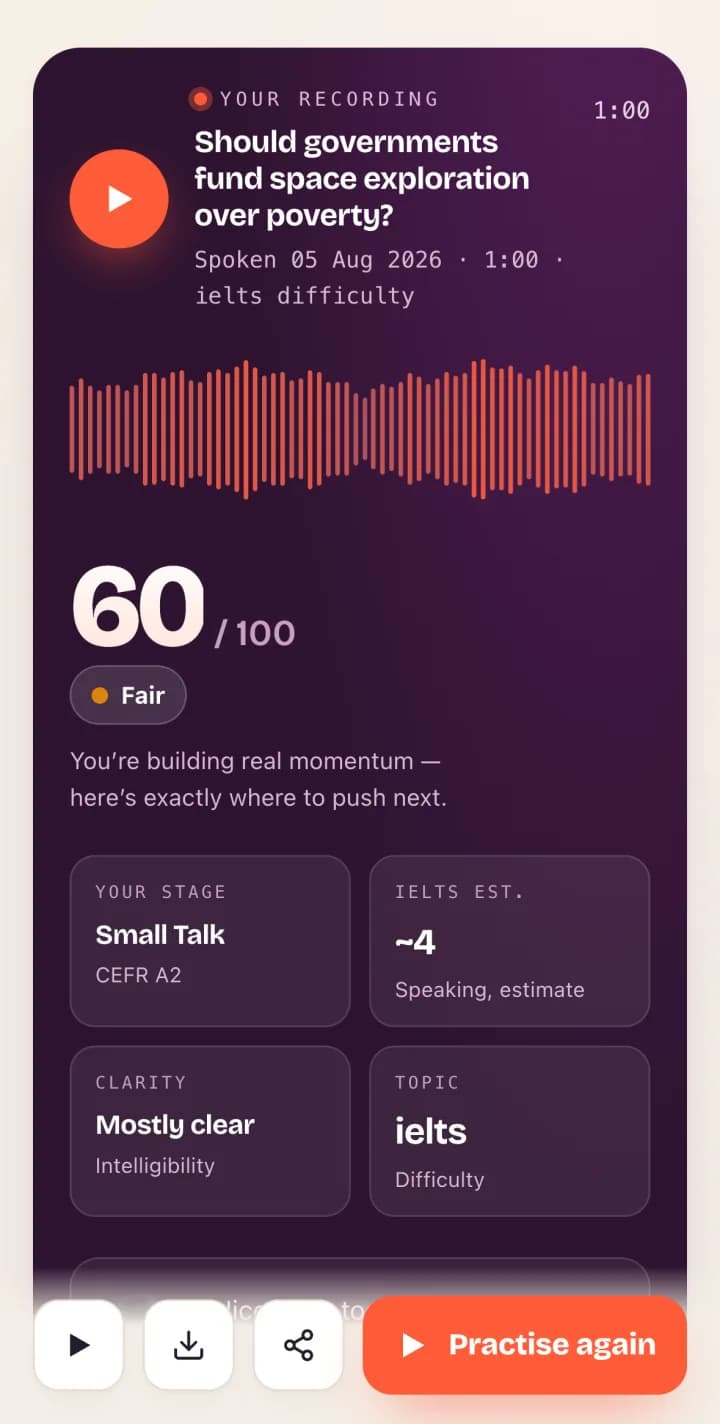
The estimate matters less than the breakdown. "You are B1" is not something you can act on tomorrow; "your grammar is ahead of your fluency, and you pause longest at the start of an answer" is.
You can take a version of this before you have an account.
The daily 60-second session
The core habit, and deliberately the smallest thing in the product. One topic, one minute, one report. It is short because a daily practice you can face when you are tired is worth more than a thorough one you skip.
Every mistake found in a session is written to a record that does not reset. That record is what later decides which drills you get, which grammar chapter you are pushed towards, and which sounds come up in pronunciation practice. Nothing you get is generic; it is assembled from your own errors.
What is stored is not the sentence you got wrong but the rule behind it, phrased so it can be tested on any topic, because the topic changes every session and a stored sentence would never come up again. Later sessions are quietly checked against it: did you produce the right form, repeat the error, or avoid the construction altogether? A mistake is not cleared when you are told about it. It is cleared when you have produced the right form three times, spontaneously, on topics you were not expecting.
Each mistake also carries a confidence flag. Speech recognition is less accurate on accented English, so when the words a correction depends on came back uncertain, the mistake is shown to you but never counted against your score or stored. Being marked wrong for something you did not say is worse than missing a real error, so the tie goes to you.
Real conversations, in the situations you are dreading
Practice modes cover the situations people actually lose English in: job interviews, debates, travel, business meetings, IELTS-style exam practice and open conversation, each marked with a level so you are not thrown into something two stages above you.
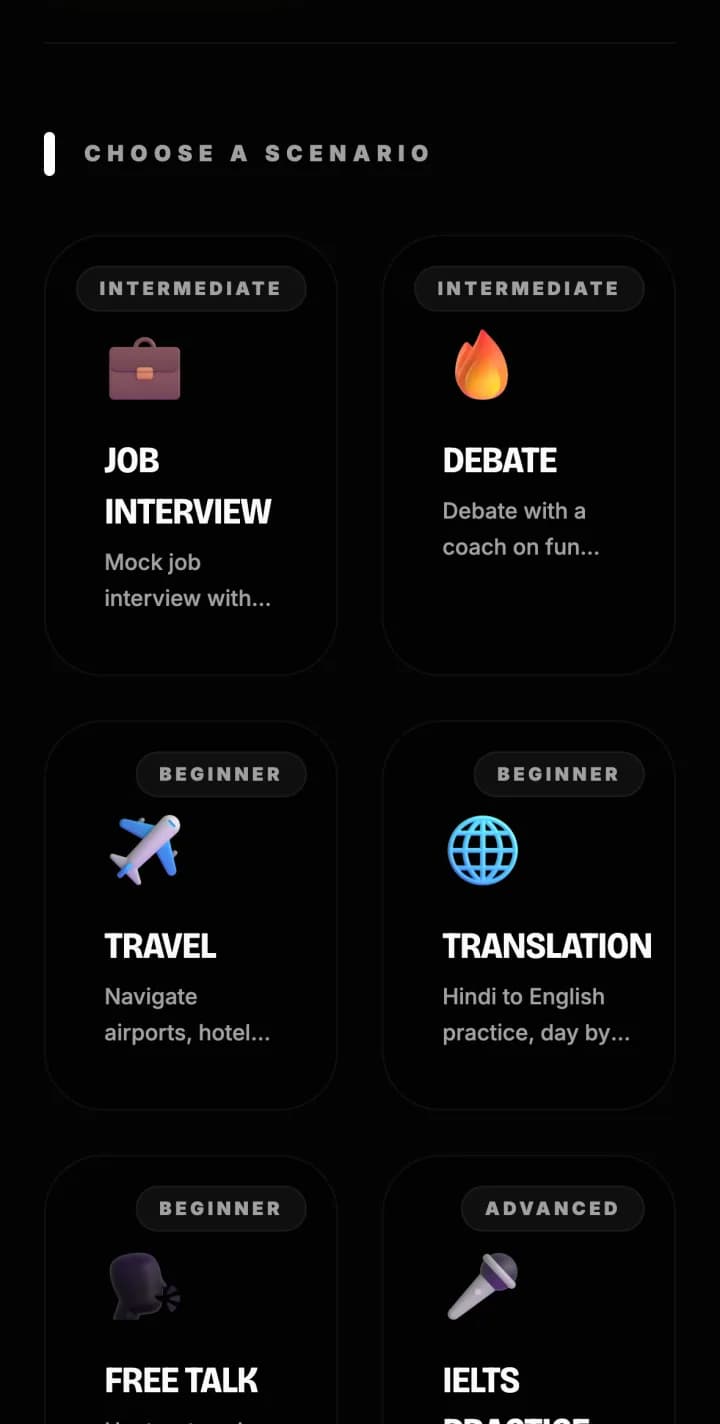
Rehearse mode goes further, and is the feature people come back for. You describe the conversation you actually have coming up, the role, the organisation, the question you are afraid of, and Speakle builds that specific conversation: a persona, an opening line, the questions likely to come up and the language worth having ready. Then you run it as many times as you want.
The live AI coach takes the other side of it face to face, on video, answering in real time. It hears your pronunciation, notices the mistakes and keeps the conversation moving. If you go blank, one tap shows three ways to say what you mean, with the meaning in your own language. Nothing is scripted.
Pronunciation, ordered by the language you already speak
Most pronunciation courses teach every learner the same list of sounds in the same order. That is close to useless: an Arabic speaker has had both TH sounds since childhood and has never produced a /p/, while a Japanese speaker needs the L and R contrast before anything else.
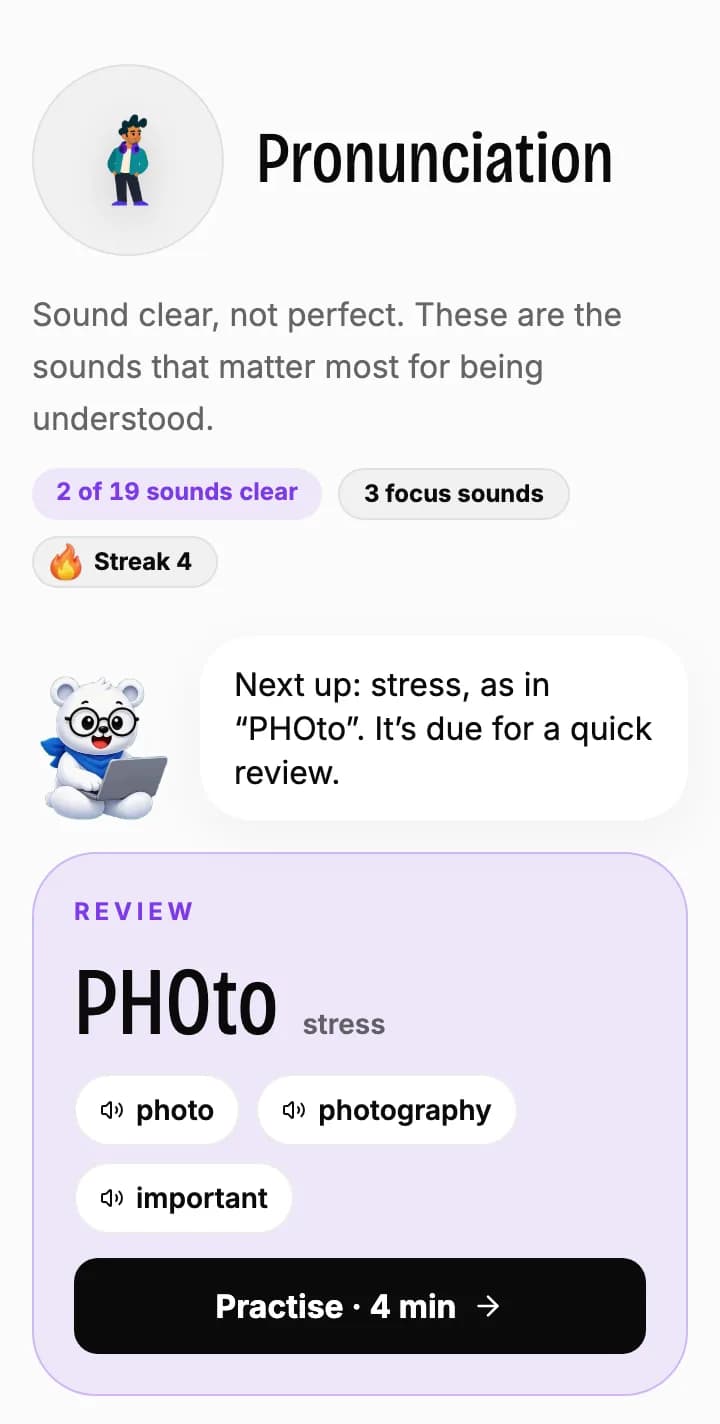
Speakle builds the path from your first language. Sounds it merges are pulled to the front; sounds it already gives you are dropped from your path entirely. Each one is worked in the order that makes it stick: hear the contrast first, then produce it, then in words, then in your own spontaneous speech. There is a public page for each of the nine languages setting out exactly which contrasts it collapses and why.
Sounds are named the way a teacher names them, by a word you already know and the letters that spell it, rather than as phonetic symbols, unless you turn symbols on.
Keep talking until you run out
The Extempore Marathon is the opposite of the 60-second session: one topic, and you keep going for as long as you can, up to twenty-five minutes of continuous speech.
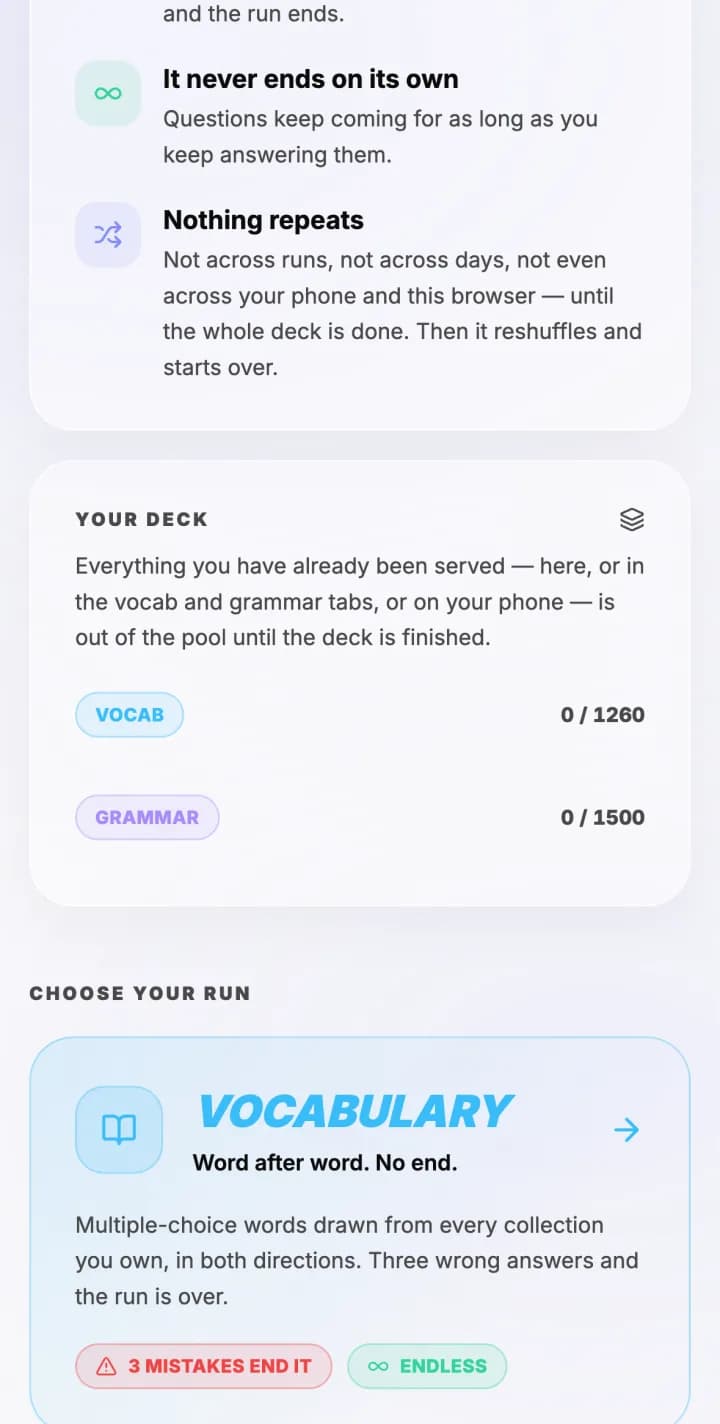
It trains something the short format cannot, which is what happens after your prepared material runs out. That is the moment real conversations actually break down, and it is almost impossible to rehearse by yourself.
Talk to another learner, then get coached on it
Video conversation matches you with another learner at your level for about ten minutes, and then coaches you both on what you actually said.
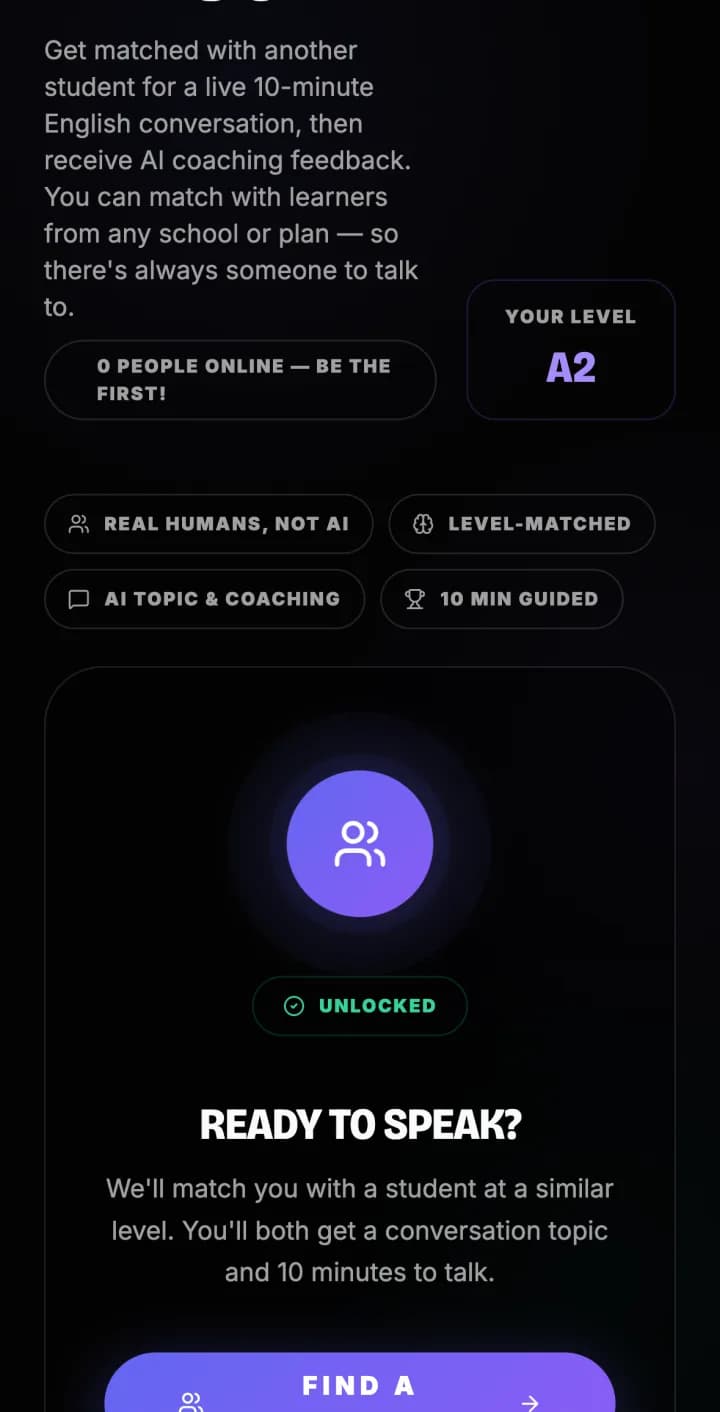
An AI partner is patient and never judges you, which is exactly why it cannot fully prepare you for a person who interrupts, changes the subject and does not slow down. This is the bridge between the two.
Stories you have to retell
Listen to a short story at your level, then say it back in your own words. The retelling is scored, which turns listening practice into speaking practice.
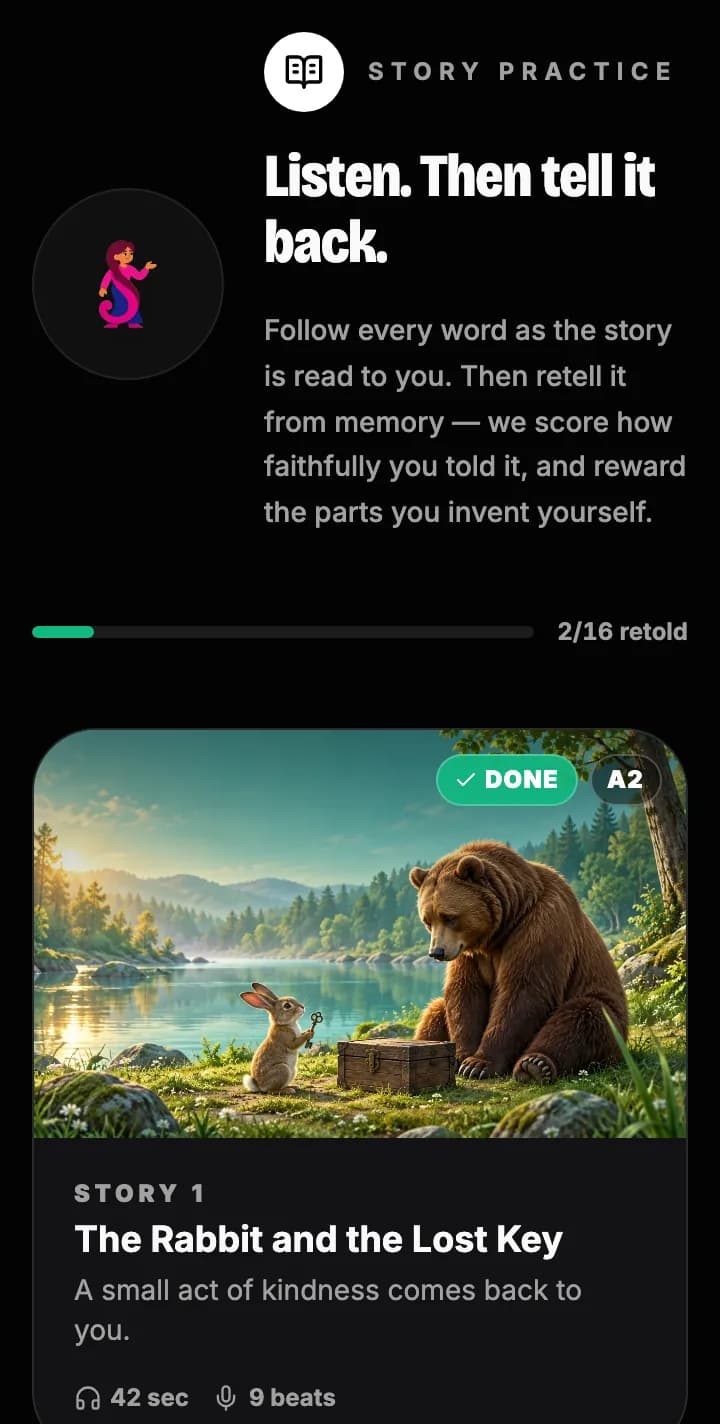
Retelling is a harder test than answering questions about a story and a much better one: you cannot do it by recognising the right option, only by producing the language yourself.
Vocabulary you meet, not vocabulary you are given
Tap any word you hear anywhere in the app to keep it. Your own word bank comes back for review on a schedule, alongside collections grouped by level and topic.
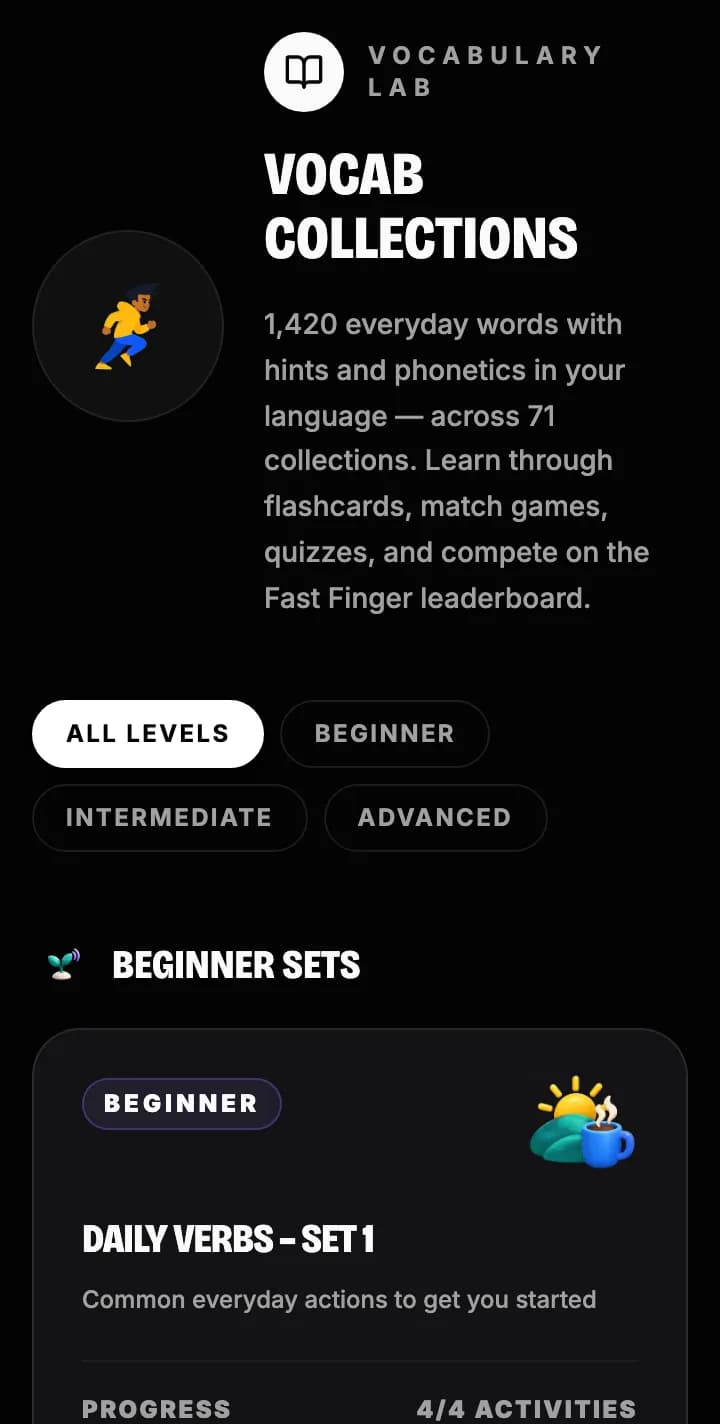
Definitions and examples are written inside a restricted defining vocabulary, so a word is never explained using three words that are harder than the one you looked up.
Grammar aimed at your own mistakes
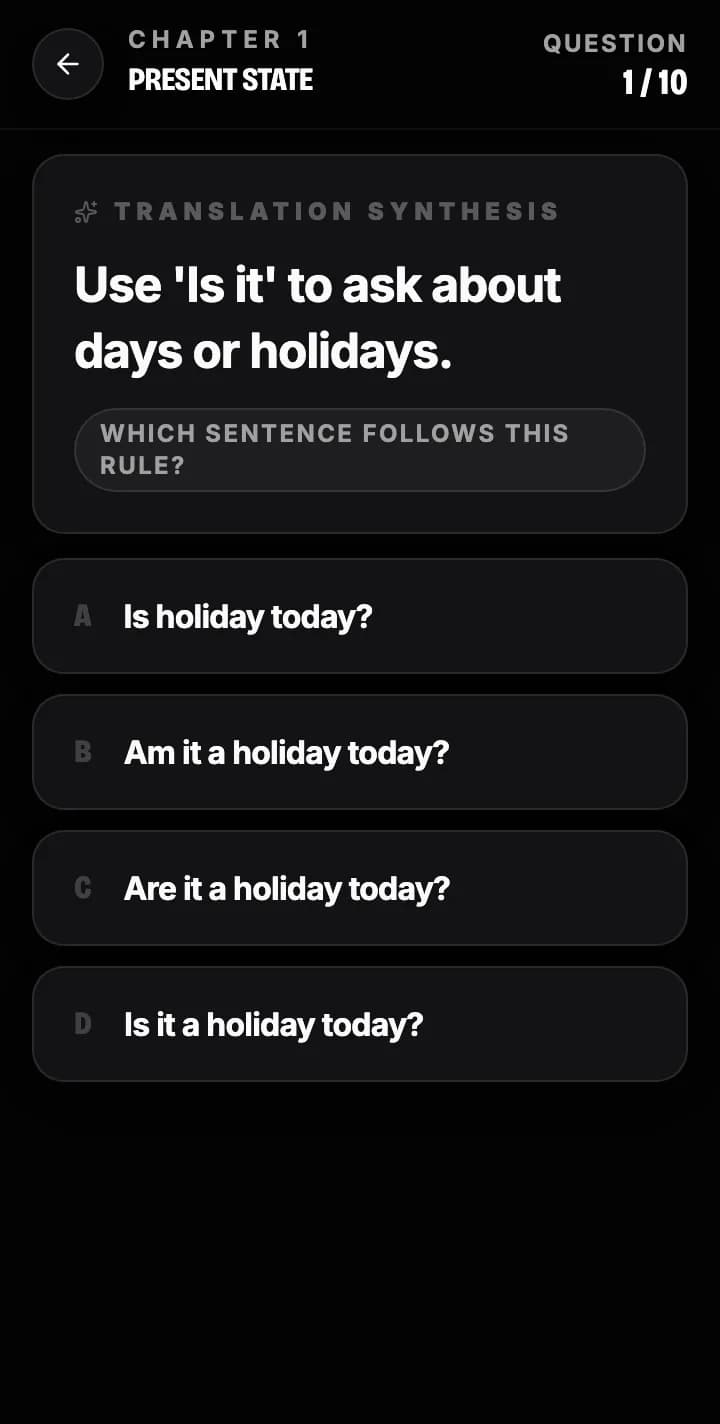
Grammar chapters with quizzes, and explanations available in your own language, because the moment you need your first language is the moment English has already stopped working.
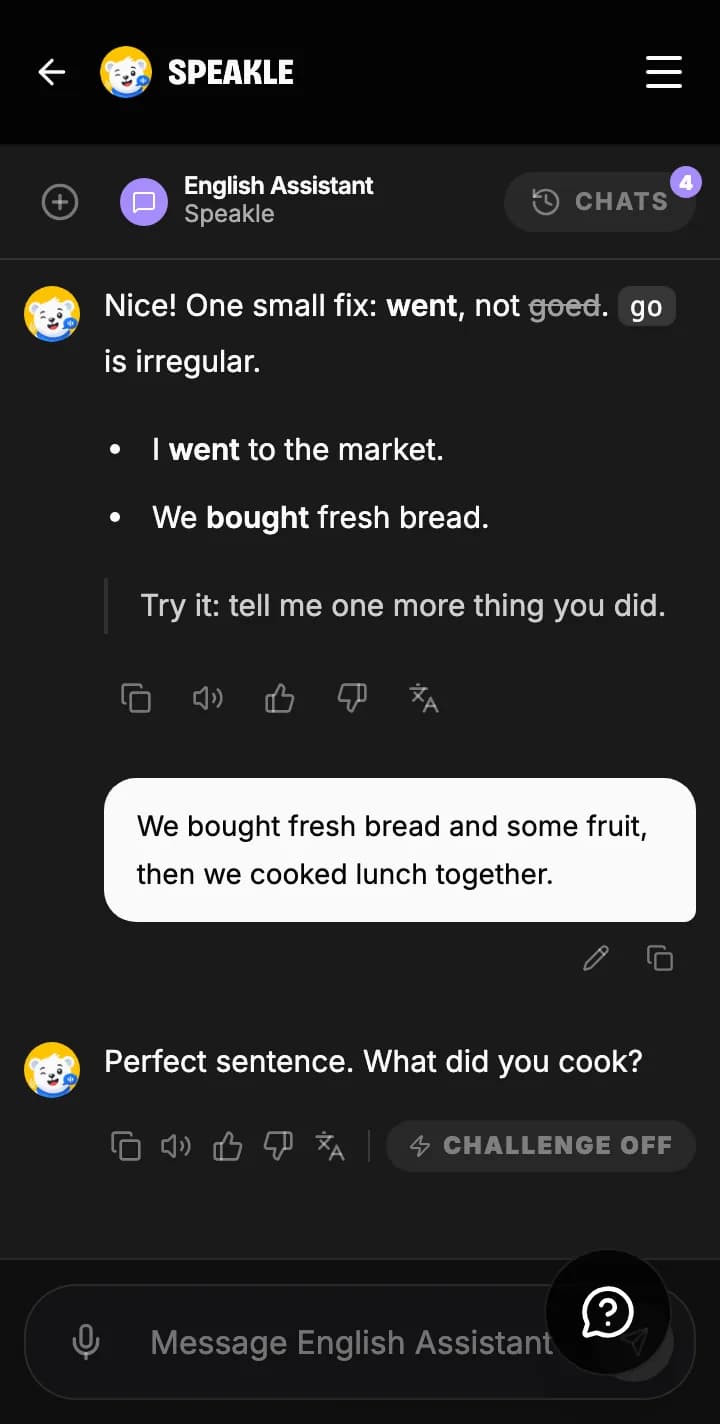
The same applies when you are chatting with the AI coach, by voice or by typing. A mistake is corrected in the reply, shown against what you actually wrote, and followed by a prompt to use the right form at once, because a correction you use immediately is the one that sticks.
The quizzes are not the point on their own. The point is that the mistakes found in your speaking decide which chapters you are pushed towards, so grammar study stays connected to something you got wrong out loud rather than being a separate subject.
A course that goes somewhere
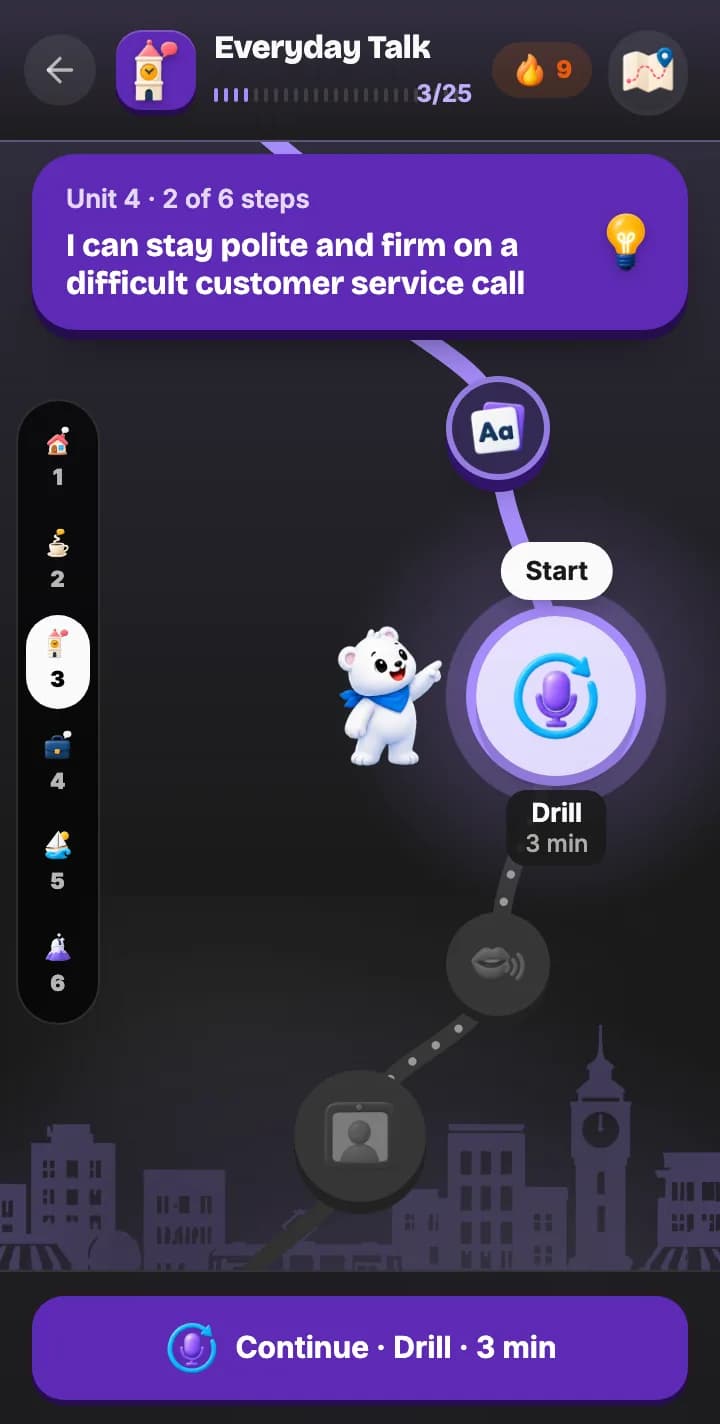
The path runs from your first words to fluent, and every unit is a thing you can say out loud rather than a topic you have covered. The spoken level check places you on it, so you start where you actually are instead of at the beginning.
Seeing that it is working
Progress is the part most apps get wrong, because a rising score is both the easiest thing to show and the least convincing.
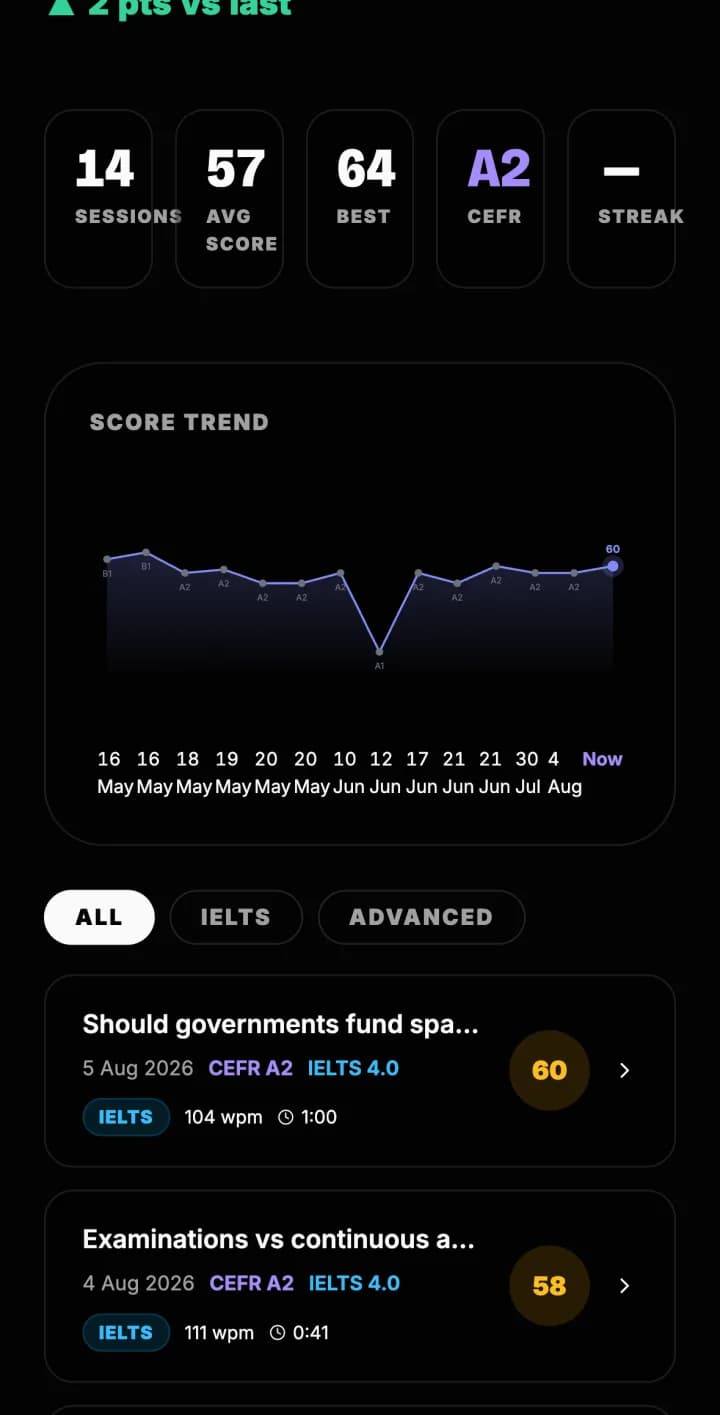
Alongside the trend you get your session history, the mistakes you have stopped making, and your own recordings over time. The recordings are the honest measure. A number going up is easy to disbelieve on a bad day; hearing what you sounded like two months ago is not.
In nine languages, for more than twenty-five countries
Hints, corrections and explanations come in Arabic, Hindi, Japanese, Korean, Malay, Thai, Vietnamese, Turkish or Portuguese. The interface language and the explanation language are set separately, so you can read the app in English and still have a mistake explained in your own language, which is what most people actually want.
Correction strictness is a setting, not a personality: light, balanced or strict, changeable any time. Every mistake is still found and saved either way; the dial only decides how much is put in front of you in the moment.
What it does not do
Worth saying plainly, because comparison pages that only list strengths are not useful.
Speakle is not a beginner course. If you cannot yet build a simple sentence, a vocabulary app will serve you better first, and you can come back.
It does not issue credentials. The CEFR level and IELTS band are software estimates for tracking your own progress, not results anyone else will accept. How the scoring works and where it is unreliable is written out in full.
It does not replace a human teacher for anything requiring judgement about people, and its speech recognition is not perfect, which is why every session shows you the transcript it scored rather than only a number.
Where to start
The free speaking test needs no account. The free plan includes a scored session every day, daily AI chat, the first grammar chapters and a first story, with no card. If you want to see how this compares with the other apps in the category, there is an honest comparison.