



Key findings
In brief
- HelloTalk is best for confident learners who want friends and culture. Speakle is best for learners who want to become confident first.
- Where HelloTalk is strong: Real native speakers, at a scale nothing else on this shelf matches.
- Where it puts its weight: An exchange runs on goodwill and timing.
- The research: speaking improves by producing language, not only recognising it; the figures below show what the published studies measured.
- Sources: 11 references, including HelloTalk's own public pages, checked 2026-09-26.
Our verdict
The short answer
Speakle is where you build the confidence to talk to anyone. Speak every day with scored feedback, practise the hard conversations with a live video coach on paid plans, and meet learners at your level on video, with no fear of judgement. HelloTalk connects you with native speakers for exchange; Speakle makes sure you are ready when you get there.

- HelloTalk is best for
- Confident learners who want friends and culture
- Speakle is best for
- Learners who want to become confident first
Looking for a HelloTalk alternative?
Many people search for a HelloTalk alternative after a few exchanges that never quite happened: a partner who went quiet, a call that felt like too much too soon. Speakle gives you speaking practice that is always there. The free plan includes a scored session every day, the live AI video coach is ready at any hour on paid plans, and when you want people, video conversation matches you with a learner at your level. It is free to start.
HelloTalk and Speakle side by side
6 things people compare, answered for each.
 Speakle
Nervous about your first exchange call? The free speaking test shows where you stand from one private answer, with no account.
The research: HelloTalk, feature by feature
We read HelloTalk's own website, help pages and app listings and wrote down what it publicly offers on each of the lines a speaking learner cares about. Each line links to the page it came from. Where we could not find a public statement the table says so, rather than guessing.
What HelloTalk and Speakle each offer, feature by feature
| Feature | HelloTalk | Speakle |
|---|---|---|
| How you practise speaking | Voice and video chat with language partners, plus Voicerooms and livestreams for multi-person speaking and listening practice. [5] | Every session is spoken: you answer in your own words, and a live AI coach holds whole conversations with you. |
| AI conversation | HelloTalk offers a family of AI apps included with a HelloTalk membership, including Talksy, an AI conversation partner with role-play scenarios that adapts to the learner's level; the main app has AI translation and grammar correction. [6] | A scored speaking session every day on the free plan; on paid plans, a live AI video coach for interviews, debates, travel, IELTS practice and open conversation. |
| Pronunciation feedback | Talksy's speech assessment gives scores for fluency and pronunciation; HelloTalk also uses a pronunciation assessment service in its tools. [7] | Every sound scored with rhythm and intonation, on a path ordered by your first language, then checked in your own unplanned speech. |
| Course structure | Not stated publicly | A course of 109 units from A1 to C2, where every step is a task you say out loud. |
| Human teachers | Primarily peer language exchange with native speakers; livestreams feature certified teachers and native speakers running classes and Q&A sessions. [8] | No tutors to book. Schools and teachers can run their classes on Speakle. |
| Other learners | Core product is a language-exchange community: 1-on-1 chats, Moments posts with corrections, Voicerooms and livestreams. [8] | Video conversation matches you with another learner at your level for about ten minutes, then coaches you both. |
| Help in your own language | Built-in translation and transliteration across supported languages; the iOS app interface is available in 16 languages. [8] | Hints, corrections and explanations in Arabic, Hindi, Japanese, Korean, Malay, Thai, Vietnamese, Turkish or Portuguese. |
| Exam preparation | Presents native-speaker matching as useful for exam candidates (CET, GRE, TOEFL, IELTS). [9] | IELTS speaking practice under exam conditions with the live coach, with a report for each part (an estimate, not an official score). |
| Free access | Language exchange with native speakers is free; the app is free to download with an optional paid VIP membership. [5] | A free plan with one scored speaking session every day, with no card. |
| Languages taught | Practice in 260+ languages, including English. [5] | English only. |
| Where it runs | iOS, Android and web. [10] | Web, with iPhone and Android apps in early access. |
HelloTalk: read on its own public pages, checked 2026-09-26. Features change; the numbered sources show where each line came from. No prices are listed because they vary by country and change often.
HelloTalk and Speakle suit two different moments, and many learners are glad to have both.On using HelloTalk and Speakle together
Which one should you choose?
Choose HelloTalk if
You already speak English with some confidence, you want native-speaker friends and cultural exchange more than a structured course, and you enjoy helping others with your own language in return.

Choose Speakle if
You want to feel ready before you talk to strangers, and to keep improving between those conversations. Speakle gives you a scored speaking session every day on the free plan, a live AI video coach on paid plans that never tires of you, mistakes kept until they are gone, and live video practice with other learners at your level, people working towards the same goal with no pressure to perform.
Start with the free speaking test, which needs no account. Then create a free account: the free plan includes a scored speaking session every day, with no card, and the first one takes five minutes.
What HelloTalk is, and what it does well
What HelloTalk is
HelloTalk is a language exchange app: you help people with your language and they help you with theirs, by text, voice notes, audio and video calls, voice rooms and a Moments feed where members post and correct each other. Built-in AI helps with translation and grammar checks, and the community spans a huge range of languages.
What HelloTalk is genuinely better at
Real native speakers, at a scale nothing else on this shelf matches. HelloTalk puts you in touch with people who grew up speaking English and are curious about your language in return, which brings culture, slang, humour and friendship that no app can script. For a learner who wants to know how people actually talk, and to make friends along the way, that community is a genuine gift.
Where its design puts its weight
An exchange runs on goodwill and timing. Your partner is a friend rather than a teacher, their time is shared with learning your language, and whether a conversation happens today depends on who is online and in the mood. That makes it warm and unpredictable, and it leaves structure, measured feedback and a record of your recurring mistakes largely up to you.
What you get with Speakle
- 109course units, A1 to C2
- 112word collections
- 49grammar chapters, explained in your language
- 12world accents to train your ear
- 9native languages for explanations
One course, every level
| Item | Value (h) |
|---|---|
| A1 | 90 to 100 |
| A2 | 180 to 200 |
| B1 | 350 to 400 |
| B2 | 500 to 600 |
| C1 | 700 to 800 |
| C2 | 1,000 to 1,200 |
Cambridge English estimates that each level takes roughly another two hundred hours of guided learning. The hours vary with the learner and with how much they practise between lessons, which is why a little speaking every day matters more than an occasional long session.
Source: Cambridge English (2026) Cambridge describes these as a guideline only.
Speakle’s video conversation matches you with another learner at your level for a ten-minute English conversation, and then coaches you on how it went. Nobody is judging your accent or waiting for their turn to practise their own language; you are both there for English. Clubs gather learners who share your first language, a Duo gives you and a friend one shared speaking goal each week, and weekly Leagues count the minutes you speak. When you would rather practise with no audience at all, the AI coach is there at any hour, and on paid plans the live video coach runs interviews, debates, trips and more.
Speakle · the English practice app for fluency and confidence
One app for everything that gets you speaking
Most apps train one piece: words, sounds or a chat window. Speakle puts the whole road to fluent, confident English in one place, and every part of it ends with you speaking.
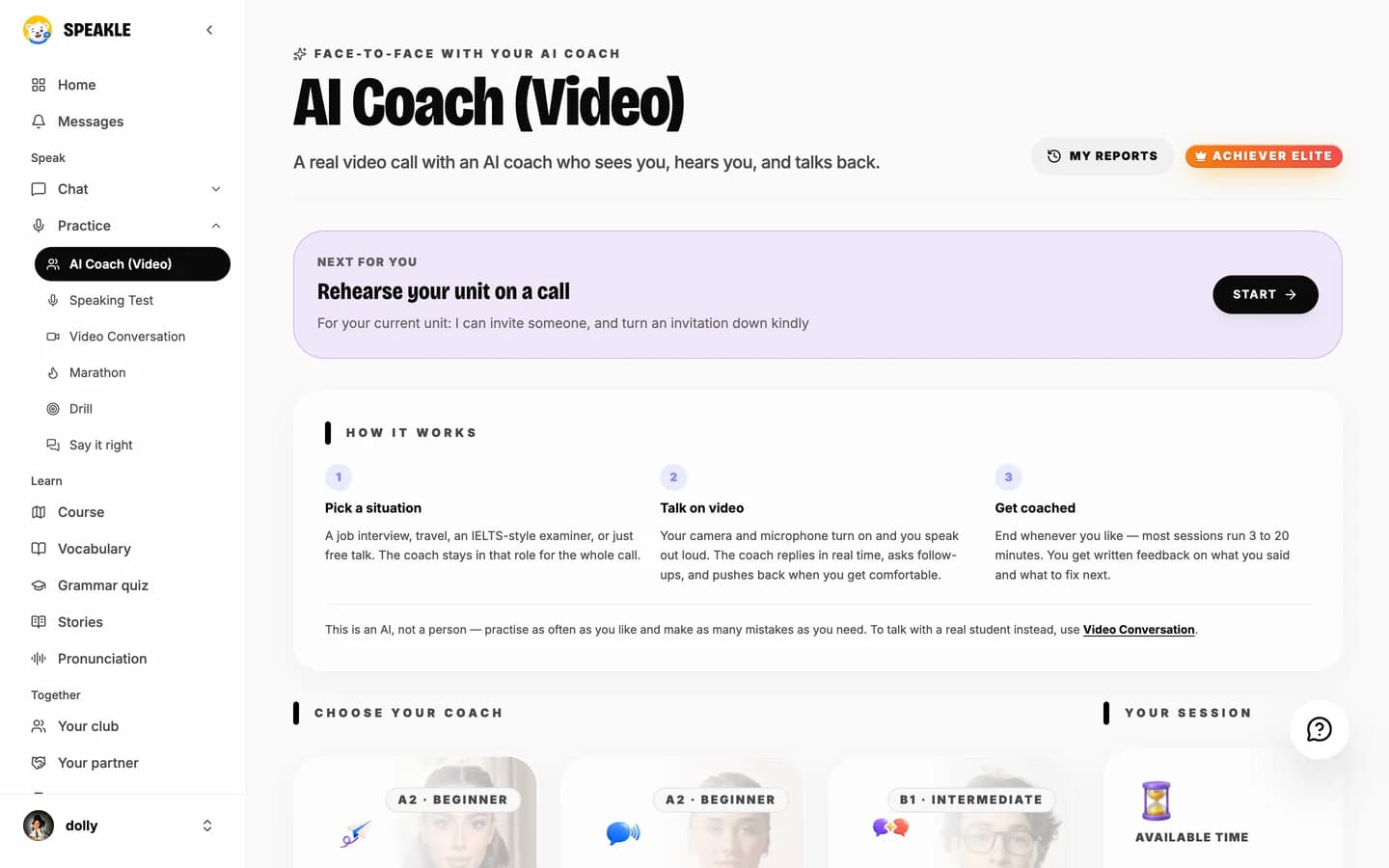 Live coachFace to face with an AI coach, on videoJob interviews, debates, travel, IELTS speaking or an open conversation. The coach stays in role for the whole call and nothing is scripted.
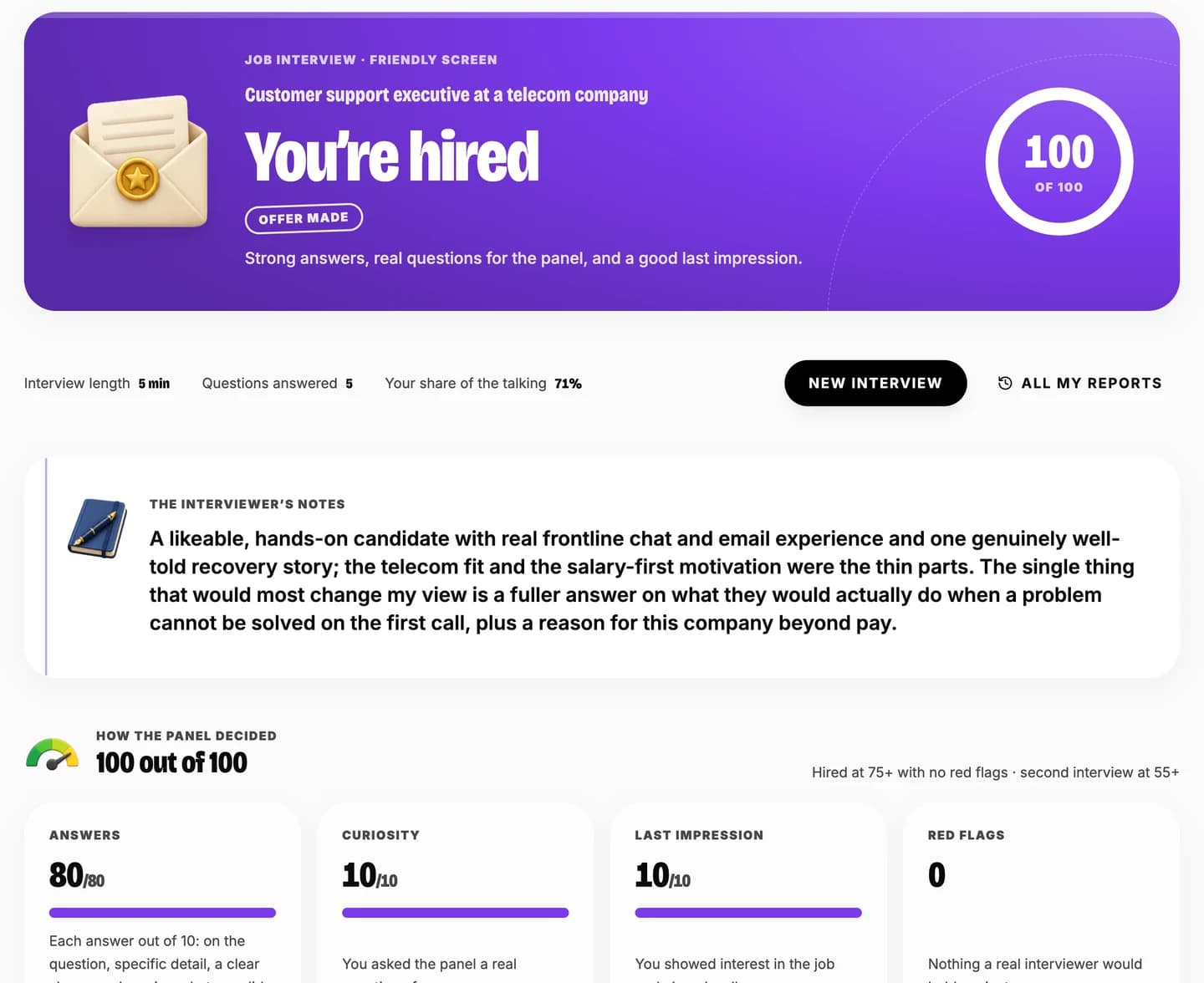 ReportsA report after every callAn interview ends in a hiring decision, a debate is won or lost, a trip earns a stamp at each stop.
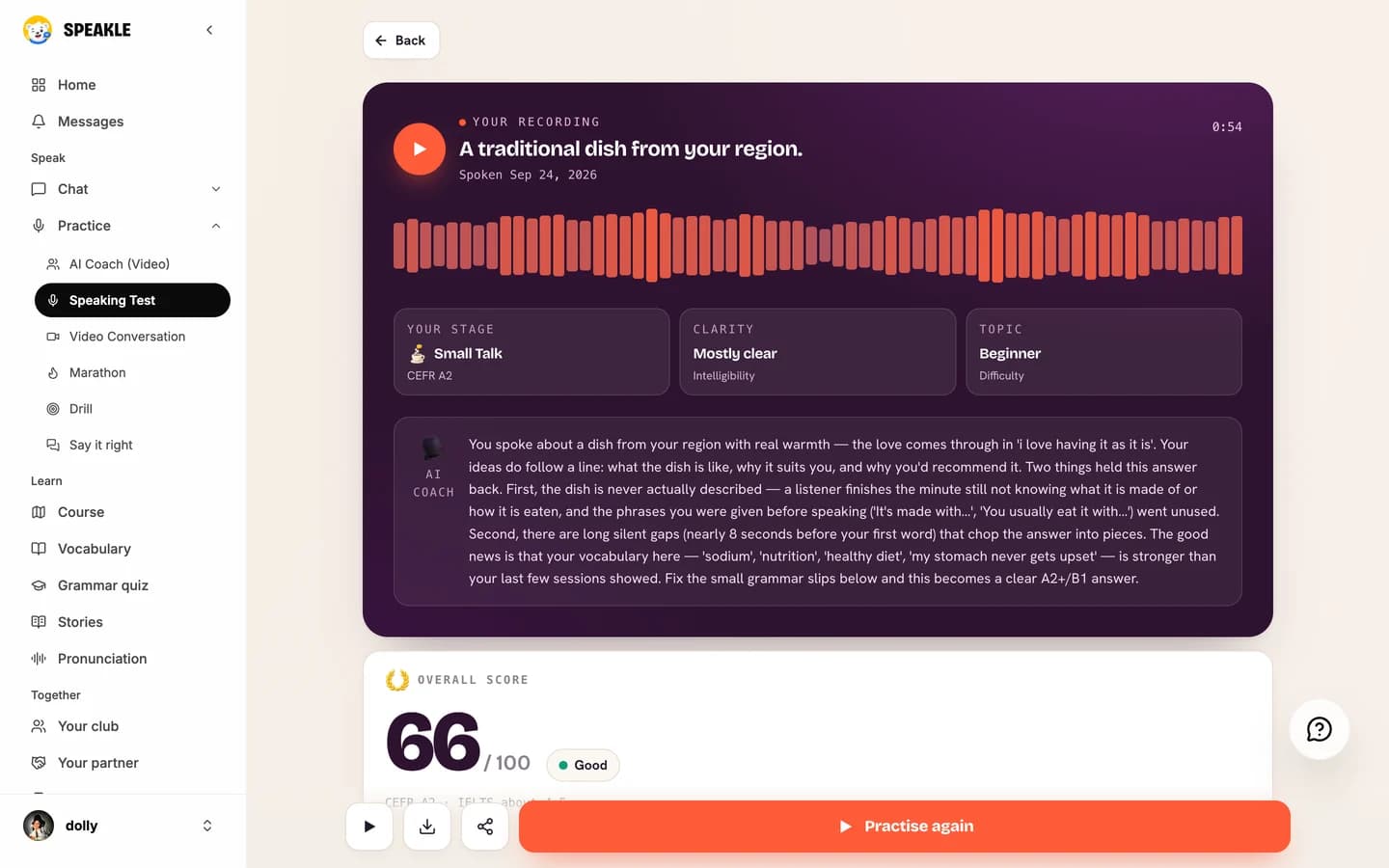 Every sessionYour speaking, measuredPronunciation, fluency, grammar, vocabulary and coherence, with a CEFR level and the one thing to fix first.
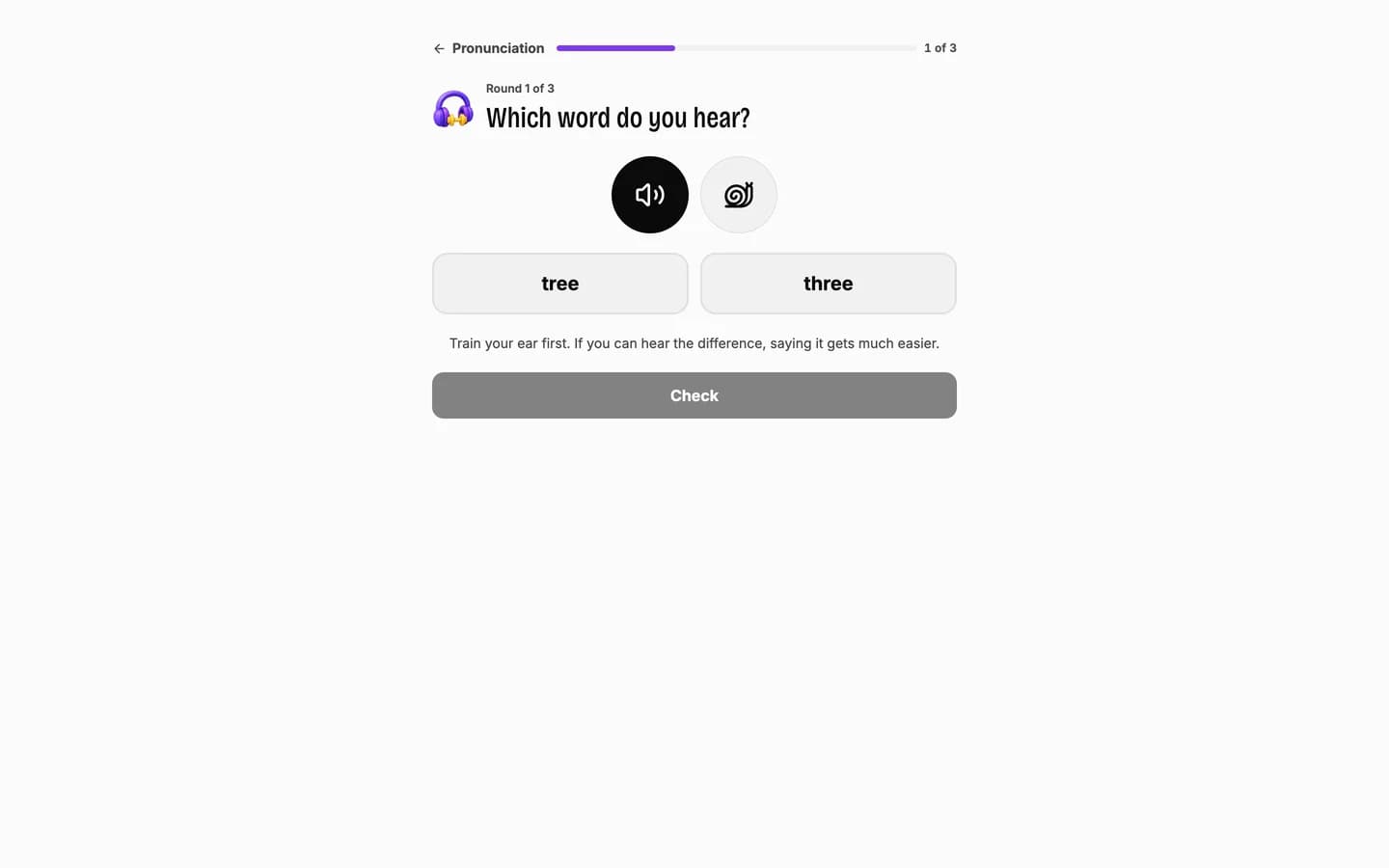 PronunciationPronunciation from your first languageSounds your language merges come first; sounds it already gives you are skipped.
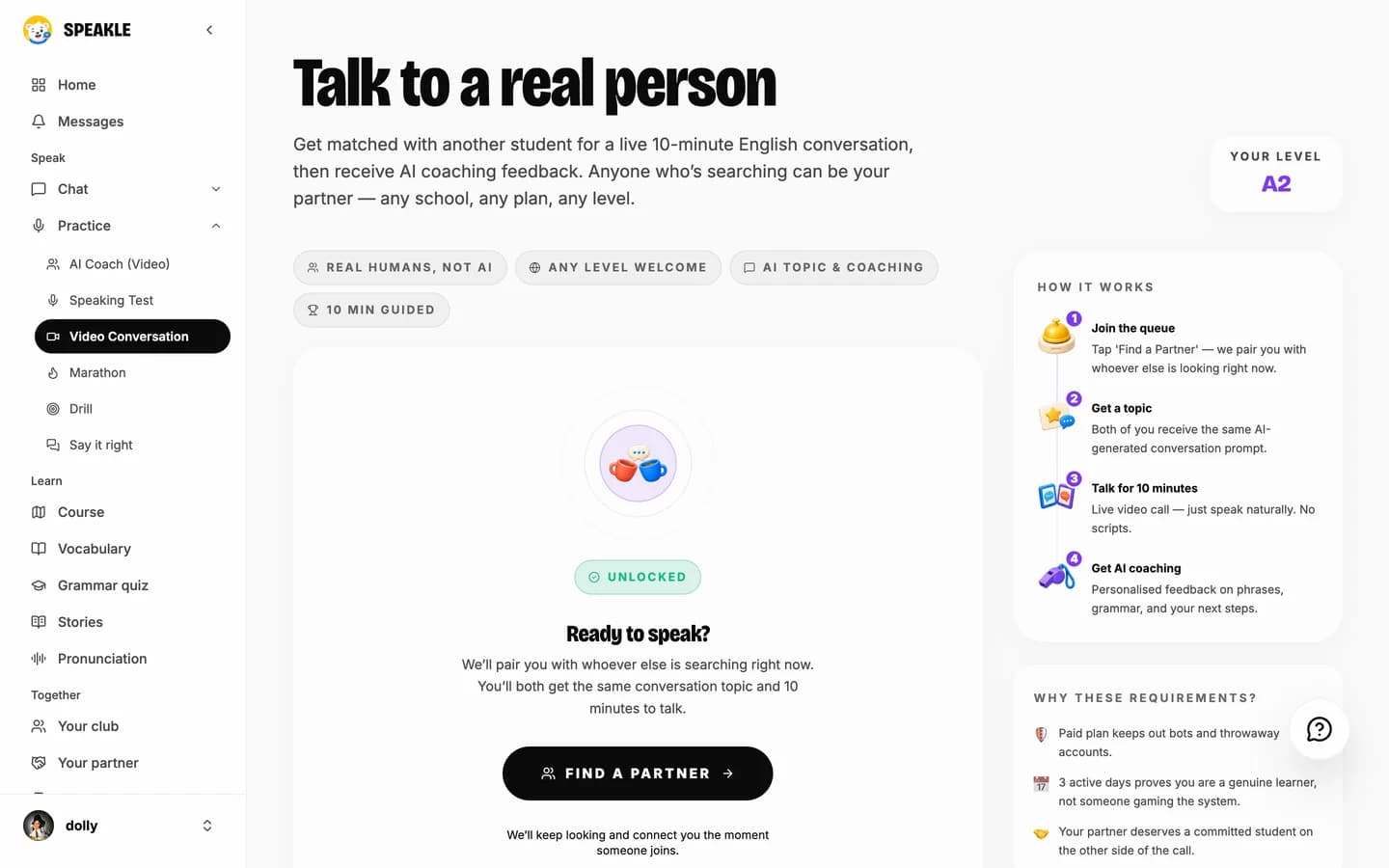 PeopleReal learners, on videoTen minutes with another learner at your level, then coaching on what you both said.
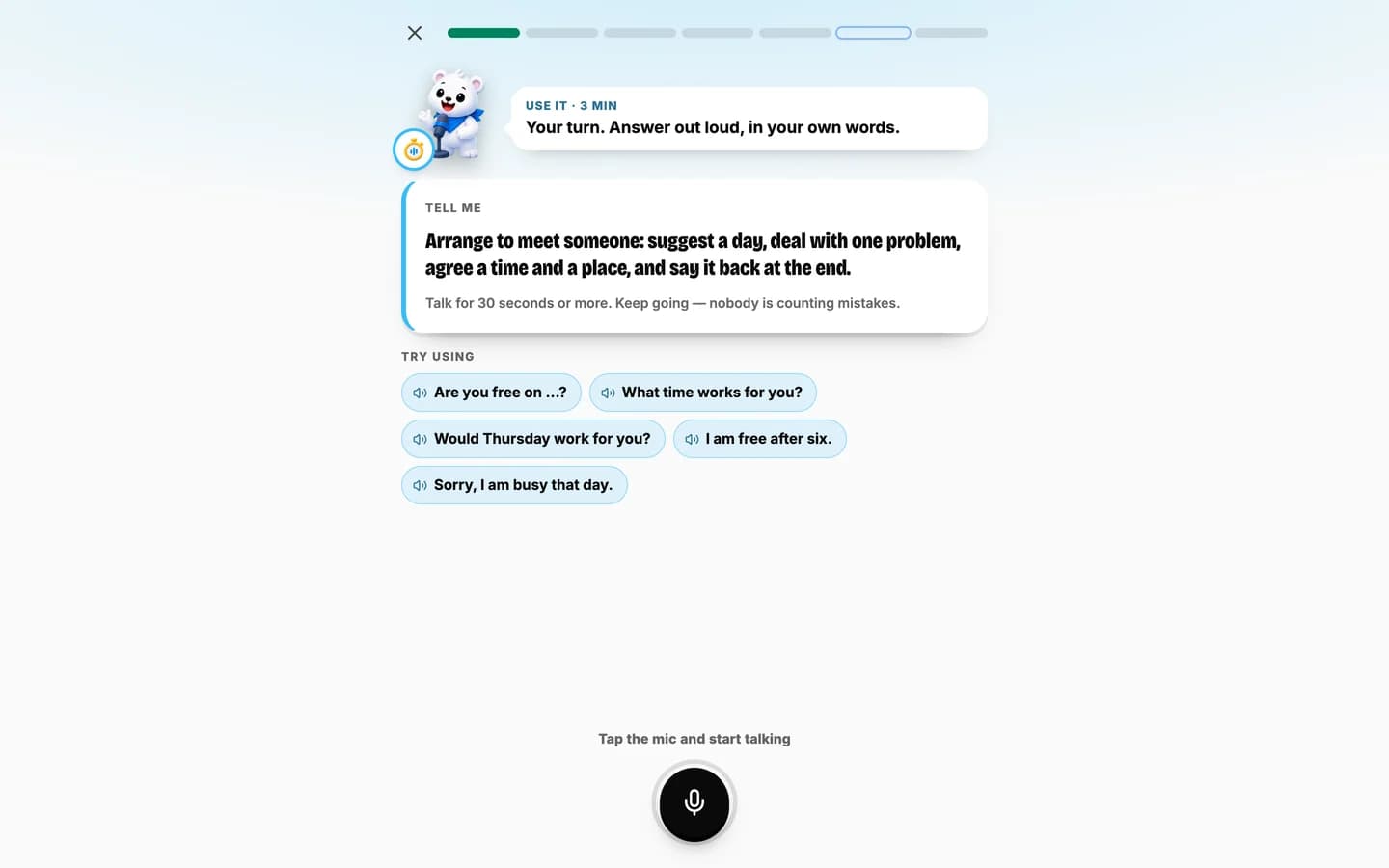 CourseA course where every step is spoken109 units from A1 to C2. Each step is a real task you say out loud, not tiles to tap.
Using HelloTalk and Speakle together
HelloTalk and Speakle suit two different moments, and many learners are glad to have both. Use Speakle to get ready: daily spoken practice with scores, a live video coach for the conversations that scare you, and learners at your level to try it all on with no pressure. Then take that confidence to HelloTalk, where native speakers can show you the slang, humour and culture a coach cannot. When an exchange partner corrects something you said, say it again in your next Speakle session and let the report tell you whether it held.
The short version of the argument
Recognising
- Tap the right option
- Match the pairs
- Repeat a sentence you were given
What most practice trains
Producing
- Find the words yourself
- Say them out loud
- While someone waits for you
What speaking needs
Recognising the right answer and producing it are different skills, and most practice trains the first. Tapping the right option, matching pairs and repeating a sentence you were given can all be done without finding a single word yourself, which is why people who understand English well still freeze when they have to speak it. We call this the recognition trap. The way out is spoken practice, short and daily, answered in your own words. The full explanation, with the memory research behind it, is its own page.
| Item | Condition | Value (%) |
|---|---|---|
| After 5 minutes | Read once, recalled 3 times | 71 |
| After 5 minutes | Read 3 times, recalled once | 78 |
| After 5 minutes | Read 4 times | 83 |
| After 1 week | Read once, recalled 3 times | 61 |
| After 1 week | Read 3 times, recalled once | 56 |
| After 1 week | Read 4 times | 40 |
Students who reread a passage four times remembered the most after five minutes, and the least a week later. Students who read it once and then tried to recall it three times forgot far less. Pulling words out of your own memory, which is what speaking asks of you, is what made them last.
Source: Roediger & Karpicke (2006) Experiment 2: university students recalling prose passages; share of idea units recalled.
| Item | Value (%) |
|---|---|
| Read aloud | 76 |
| Read silently | 59.8 |
| Never shown (wrongly recognised) | 21.9 |
The same people read some words aloud and some silently. Afterwards they recognised the words they had said aloud clearly more often. Saying something makes it more memorable than only seeing it, one reason spoken practice beats silent tapping for anything you want to say later.
Source: MacLeod et al. (2010) Experiment 1, 44 university students. The benefit appeared when each person read some words aloud and some silently.
| Item | Value (%) |
|---|---|
| 20 min | 47.2 |
| 1 h | 37.3 |
| 9 h | 27.6 |
| 1 day | 31.7 |
| 2 days | 23 |
| 6 days | 16.8 |
| 31 days | 4.1 |
A modern replication of Ebbinghaus measured how much faster a list could be relearned after each delay. Most of the benefit is gone within a day or two unless the material is used again, which is why a daily return to speaking matters more than a long session once a week.
Source: Murre & Dros (2015) One adult learning nonsense syllables; "savings" is the share of relearning time saved, not the share remembered.
Questions people ask
Is Speakle a HelloTalk alternative?
For building speaking confidence, yes. HelloTalk connects you with native speakers for exchange; Speakle gives you daily scored practice, a live AI video coach on paid plans, a full course and learners at your level on video, so you grow in confidence before and between real conversations.
Can I talk to real people on Speakle?
Yes. Video conversation matches you with another learner at your level for a real call, and clubs bring together learners who share your first language. You can also keep a streak going with a friend. The difference from an exchange is that everyone is there for English, at your level, rather than trading languages.
Can I use HelloTalk and Speakle together?
Yes. HelloTalk for friendship and culture with native speakers, Speakle for the daily practice that makes those conversations easier.
More comparisons
 tutor marketplace
Speakle vs italki
Looking for an italki alternative between lessons? Speakle gives you daily scored speaking, mistakes re-tested until they stop and a live AI video coach.Read the comparison community course
Speakle vs Busuu
Looking for a Busuu alternative for speaking? Speakle gives instant feedback on every spoken answer, live AI video coaches and a free A1 to C2 course.Read the comparison gamified course
Speakle vs Duolingo
Looking for a Duolingo alternative for speaking? Speakle is a free AI English speaking app: every session is spoken, scored and explained in your language.Read the comparison


Where to go next
References
- Cambridge University Press & Assessment. (2026). Guided learning hours. Cambridge English Support Site. support.cambridgeenglish.org/hc/en-gb/articles/202838506-Guided-learning-hours Checked 2026-09-26.
- Roediger, H. L., III, & Karpicke, J. D. (2006). Test-enhanced learning: Taking memory tests improves long-term retention. Psychological Science, 17(3), 249-255. doi.org/10.1111/j.1467-9280.2006.01693.x Checked 2026-09-26.
- MacLeod, C. M., Gopie, N., Hourihan, K. L., Neary, K. R., & Ozubko, J. D. (2010). The production effect: Delineation of a phenomenon. Journal of Experimental Psychology: Learning, Memory, and Cognition, 36(3), 671-685. doi.org/10.1037/a0018785 Checked 2026-09-26.
- Murre, J. M. J., & Dros, J. (2015). Replication and analysis of Ebbinghaus' forgetting curve. PLOS ONE, 10(7), e0120644. doi.org/10.1371/journal.pone.0120644 Checked 2026-09-26.
- HelloTalk, public page at hellotalk.com. www.hellotalk.com Checked 2026-09-26.
- HelloTalk, public page at hellotalk.com. www.hellotalk.com/en/ai-apps/talksy Checked 2026-09-26.
- HelloTalk, public page at hellotalk.com. www.hellotalk.com/en/features/language-ai-apps Checked 2026-09-26.
- HelloTalk, public page at hellotalk.com. www.hellotalk.com/en/features Checked 2026-09-26.
- HelloTalk, public page at apps.apple.com. apps.apple.com/us/app/hellotalk-learn-languages/id557130558 Checked 2026-09-26.
- HelloTalk, public page at hellotalk.com. www.hellotalk.com/en/download Checked 2026-09-26.
- HelloTalk, public page at microsoft.com. www.microsoft.com/en/customers/story/1615006392710416983-hellotalk-azure-ai-education-china Checked 2026-09-26.