
Why a plan helps
When you want to feel more confident speaking English, it is tempting to wait for a big opportunity: a trip abroad, a new job, a conversation club. The trouble is that big opportunities are also high-pressure ones. A plan lets you build confidence in small, low-risk steps first, so that when the big moment arrives you have already done the hard part many times.
| Item | Value (%) |
|---|---|
| Spaced practice | 47.3 |
| Massed practice | 36.7 |
Across hundreds of experiments, material practised in spaced sessions was recalled better than the same practice crammed into one sitting. Five minutes a day is spaced practice by design.
Source: Cepeda et al. (2006) Averages across many different studies of verbal recall, not a single experiment.
The plan below runs over four weeks. Each week has one focus and a short daily practice of about five to ten minutes. You can stretch any week if it feels too fast. Moving slowly is fine. Stopping is the only thing that does not work.
Before you start: record your starting point
Take two minutes to capture where you are today. It will matter later.
- Choose a question you could talk about for a minute, such as "What did you do last weekend?" or "Tell me about your job or your studies."
- Record yourself answering it for sixty seconds on your phone, without preparing.
- Save the recording, and try not to listen to it more than once.
If you would like a more structured starting point, the free English speaking test gives you an estimate of your current level from one spoken answer. Either way, keep your first recording. You will come back to it at the end.
Week 1: Get used to your own voice in English
The first goal is simple: make speaking English feel ordinary. Many learners have rarely heard themselves speak English for more than a sentence or two, so the sound of their own voice feels strange. That strangeness fades quickly with repetition.
Daily practice, about five minutes:
- Describe out loud what you are doing while you do it: making breakfast, walking to the shops, tidying your desk.
- Talk for one minute about an easy topic: a meal you love, your family, a place you like, your plans for the weekend.
- Do not stop to correct yourself. If a sentence goes wrong, finish it anyway and start the next one.
What to notice: by the end of the week, starting to speak should feel a little less like jumping into cold water. You do not need to sound better yet. You only need to have spoken every day.
Week 2: Build a bank of phrases you can use
In the second week, you start giving yourself tools. Confident speakers are not people who know every word. They are people who have reliable phrases for starting, continuing and recovering.
Collect phrases for four jobs:
- Starting an answer: "That is a good question." "Let me think." "For me, the most important thing is..."
- Giving reasons and examples: "The main reason is..." "For example, last month I..."
- Keeping going: "On top of that..." "The other thing is..."
- Recovering: "Sorry, let me say that again." "What I mean is..."
Daily practice, five to ten minutes:
- Pick three phrases from your bank and use each one in a one-minute answer.
- Rotate through everyday topics: work, family, food, travel, weekends, or a film or series you enjoyed.
- Answer the same question twice. The second time, add one phrase you did not use the first time.
What to notice: your pauses may start to fill with useful phrases instead of silence. Answers get a little longer without feeling harder.
Week 3: Rehearse real situations
Now bring your practice closer to the moments that matter to you. Think of two or three situations where you want to feel more confident, and make them specific. "Speaking at work" is vague. "Giving a short update in the weekly team meeting" is something you can rehearse.
Some situations that suit most people:
- Introducing yourself to a new colleague or neighbour
- Answering "Tell me about yourself" in a job interview
- Ordering food and asking a question about the menu
- Checking in at a hotel and asking what time breakfast is served
- Calling to change an appointment
- Making small talk with a partner's friends or family
Daily practice, about ten minutes:
- Choose one situation and note the three or four things you will probably need to say.
- Say them out loud, then imagine the other person's replies and respond to them.
- Repeat the same situation on at least three different days. It should start to feel a little boring. Boring is good: it means the situation has stopped being frightening.
An AI conversation partner is useful at this stage, because it can play the other person, respond to what you actually say, and run the same conversation as many times as you like without anyone waiting on you.
What to notice: when you imagine the real situation, does it feel slightly more familiar? That familiarity is confidence in its early form.
Week 4: Speak with other people
The last step is to take your practice into conversations with people. Keep it low-stakes at first, and choose situations you have already rehearsed.
Ideas for this week:
- Use one of your rehearsed situations for real: order the coffee, make the call, ask the question.
- Join an online conversation group or a language exchange for a short session.
- Send a voice message in English to a friend or colleague instead of typing.
- Have a short video conversation with another learner at a similar level.
After each conversation, ask yourself three questions:
- What did I manage to say?
- What was one moment that went well?
- What is one thing I would like to say better next time?
Write the answers down. Notice that the first two questions are about what went right. That is on purpose. Anxiety will point out the mistakes without any help from you.
Listen to your first recording again
At the end of the fourth week, answer the question you recorded on day one, again for sixty seconds, and then listen to both recordings. Pay attention to how quickly you start, how long you keep going, and how you handle the moments where you are unsure.
Most people hear a difference. Sometimes it is large and sometimes it is small, but it is almost always there. That recording is your proof, and it is more convincing than any score.
Speakle · the English practice app for fluency and confidence
One app for everything that gets you speaking
Most apps train one piece: words, sounds or a chat window. Speakle puts the whole road to fluent, confident English in one place, and every part of it ends with you speaking.
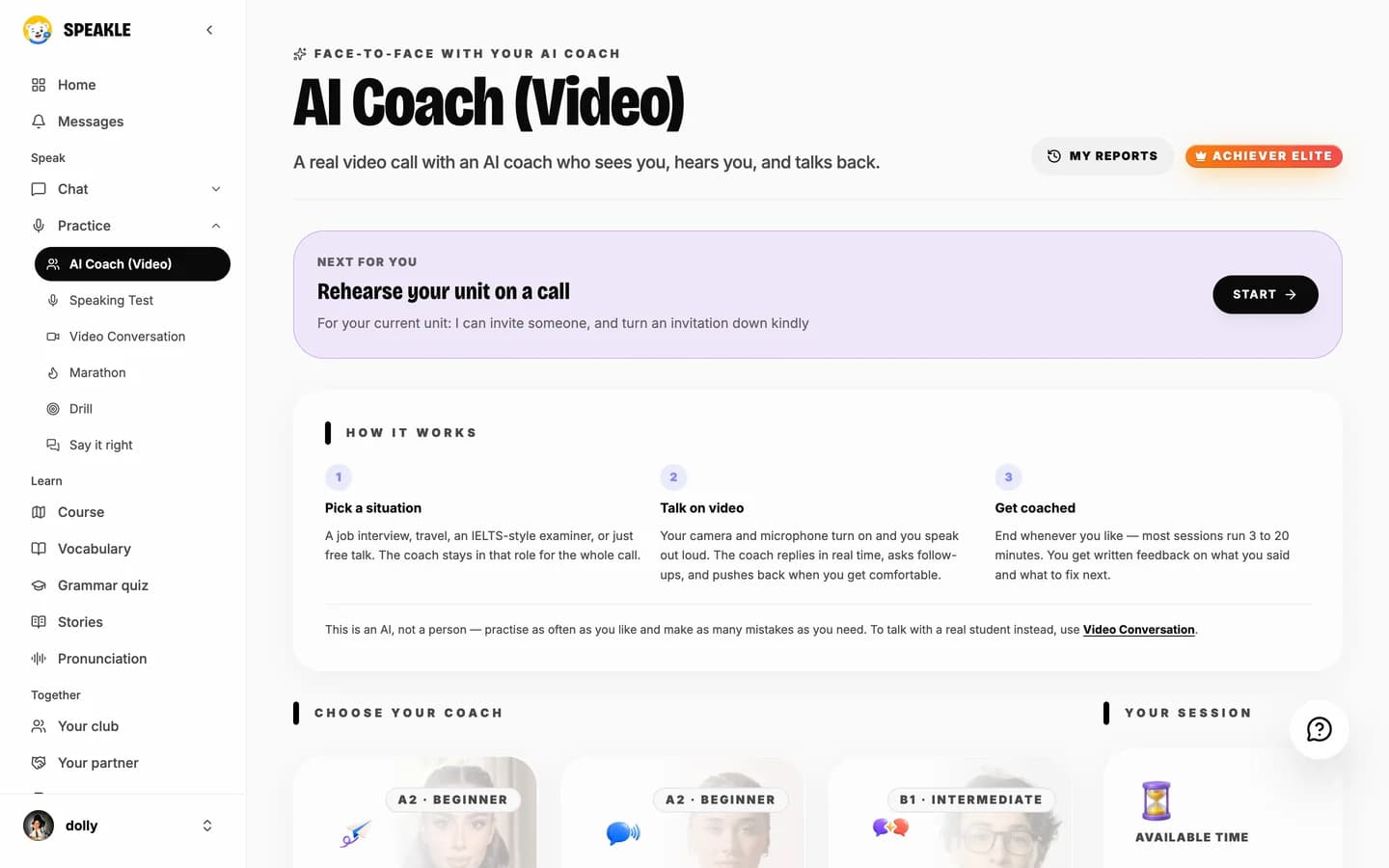 Live coachFace to face with an AI coach, on videoJob interviews, debates, travel, IELTS speaking or an open conversation. The coach stays in role for the whole call and nothing is scripted.
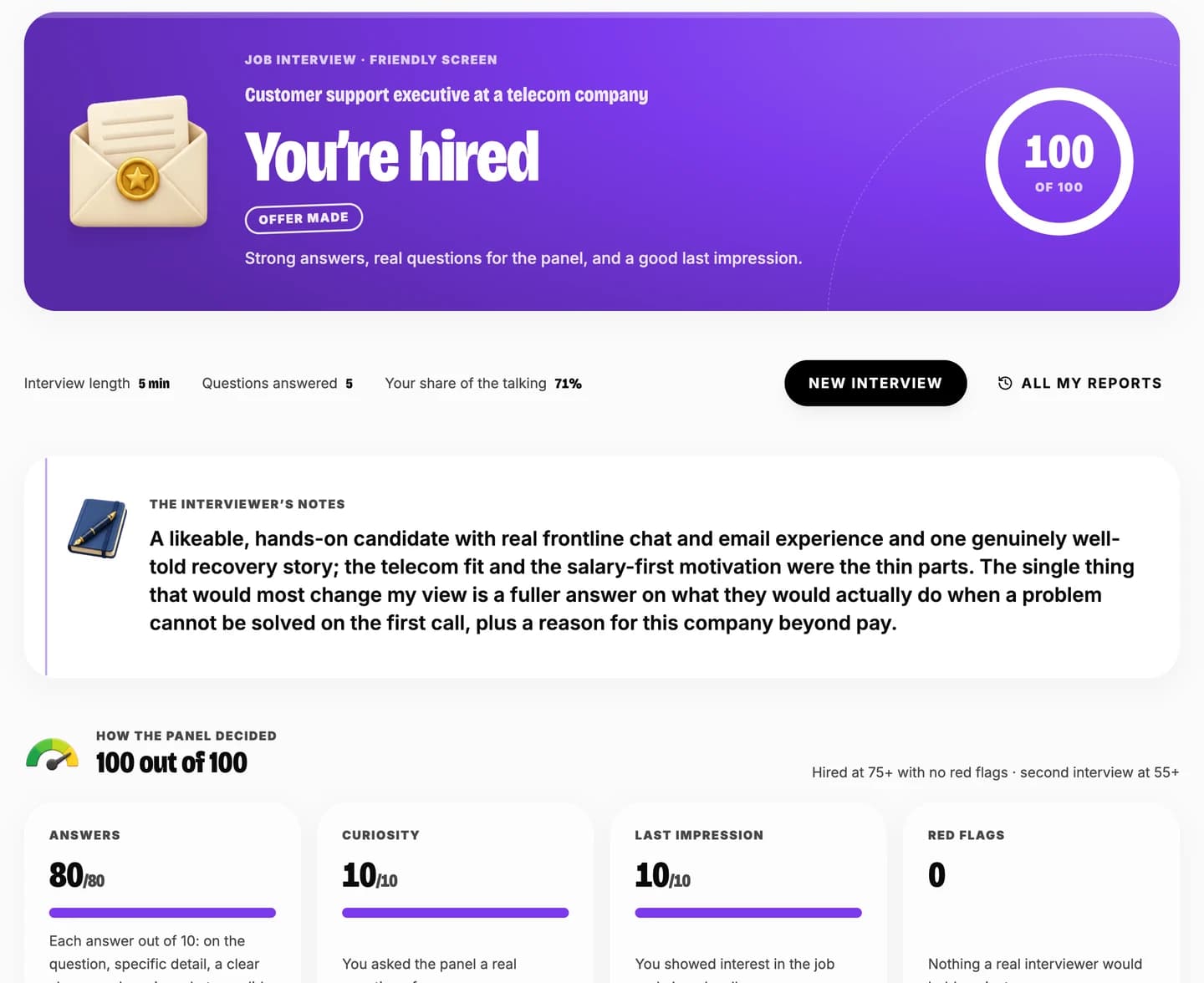 ReportsA report after every callAn interview ends in a hiring decision, a debate is won or lost, a trip earns a stamp at each stop.
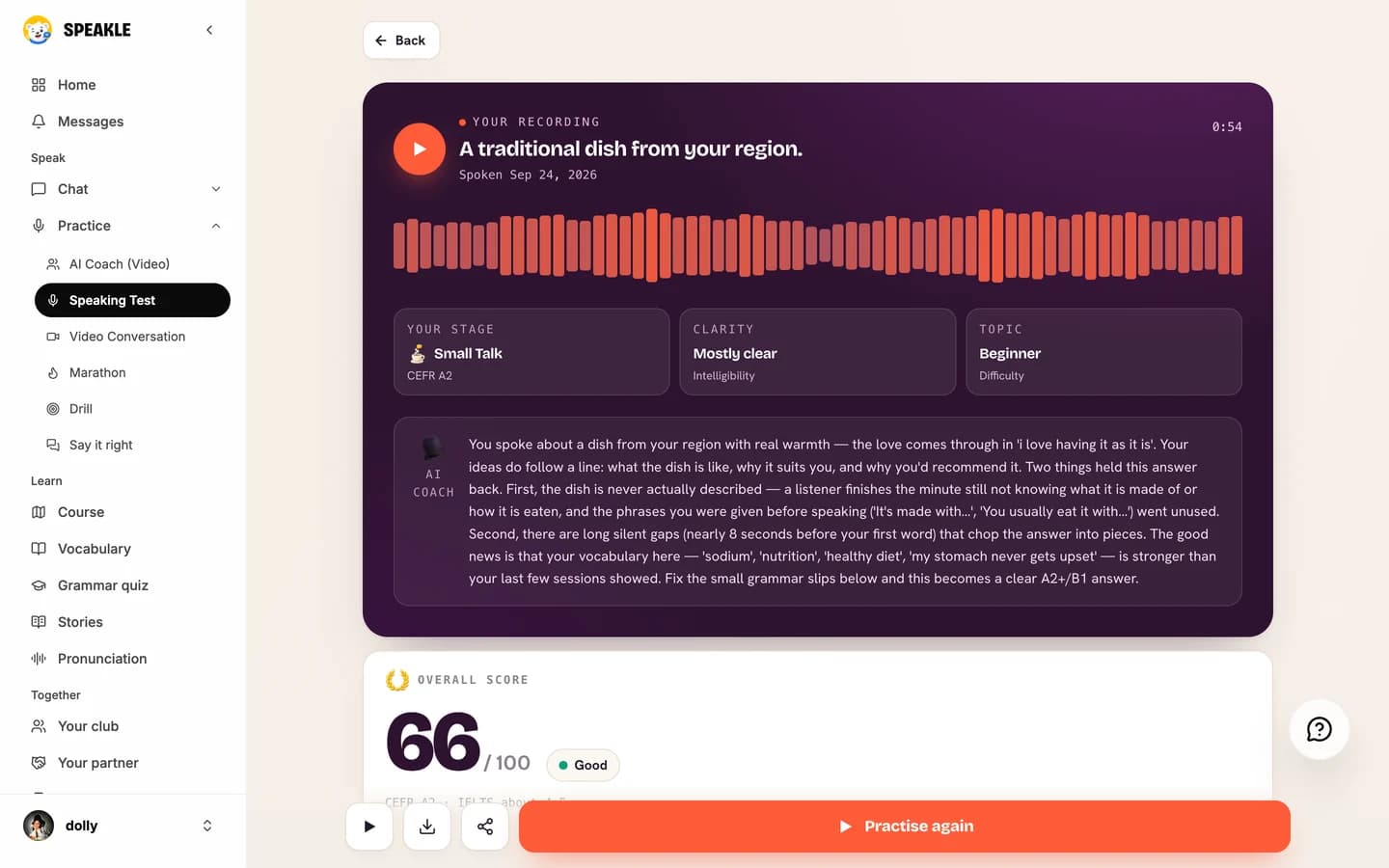 Every sessionYour speaking, measuredPronunciation, fluency, grammar, vocabulary and coherence, with a CEFR level and the one thing to fix first.
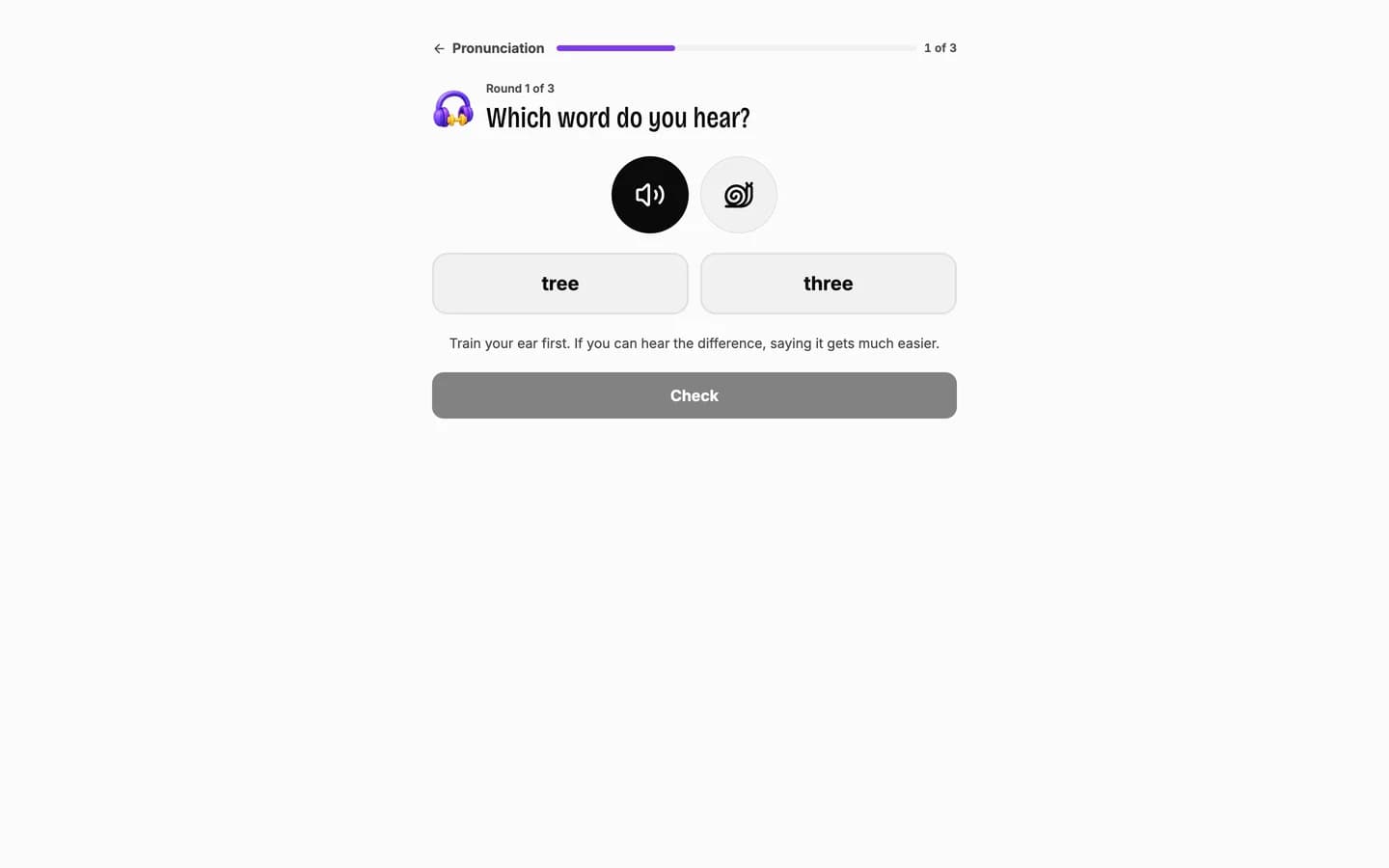 PronunciationPronunciation from your first languageSounds your language merges come first; sounds it already gives you are skipped.
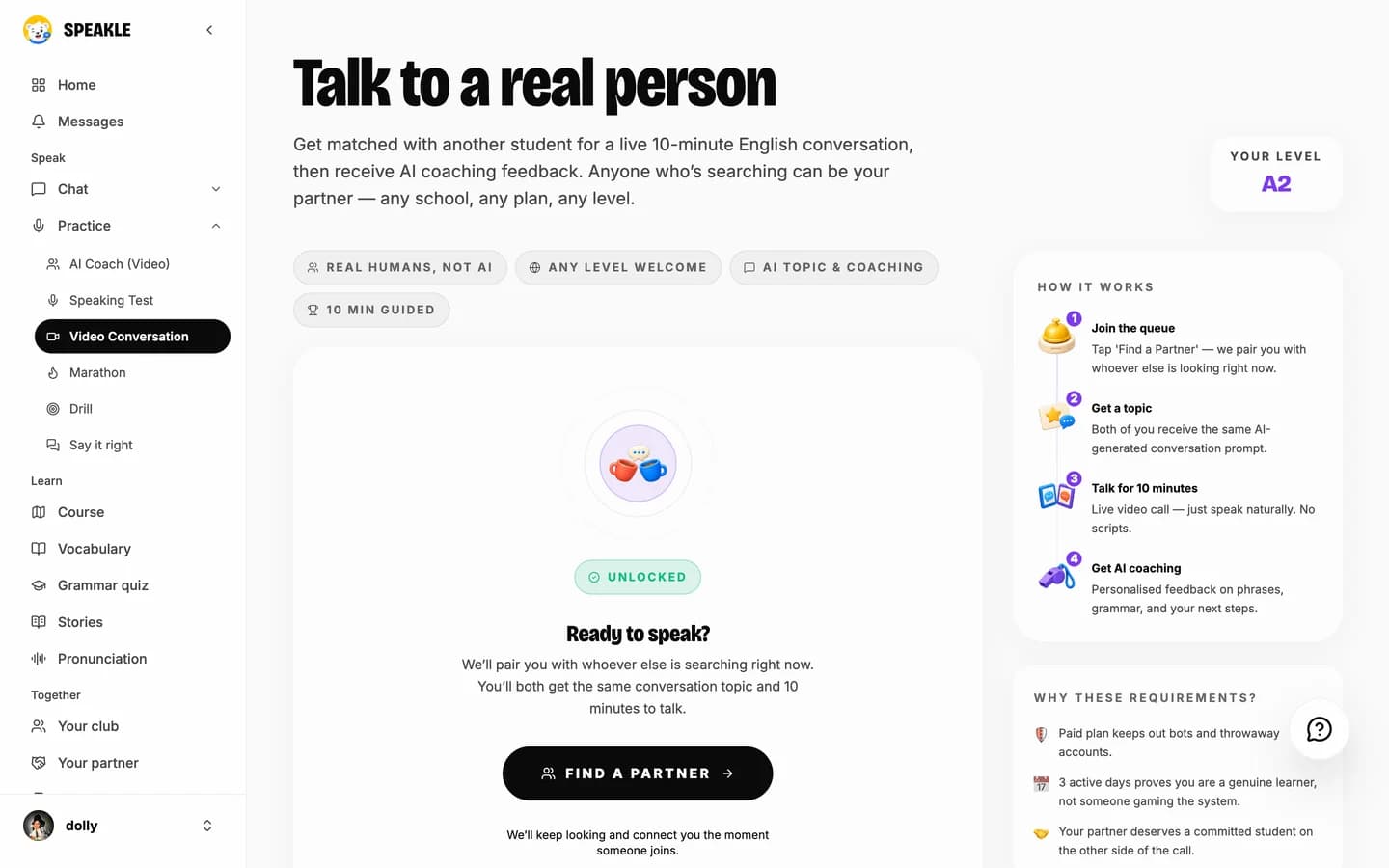 PeopleReal learners, on videoTen minutes with another learner at your level, then coaching on what you both said.
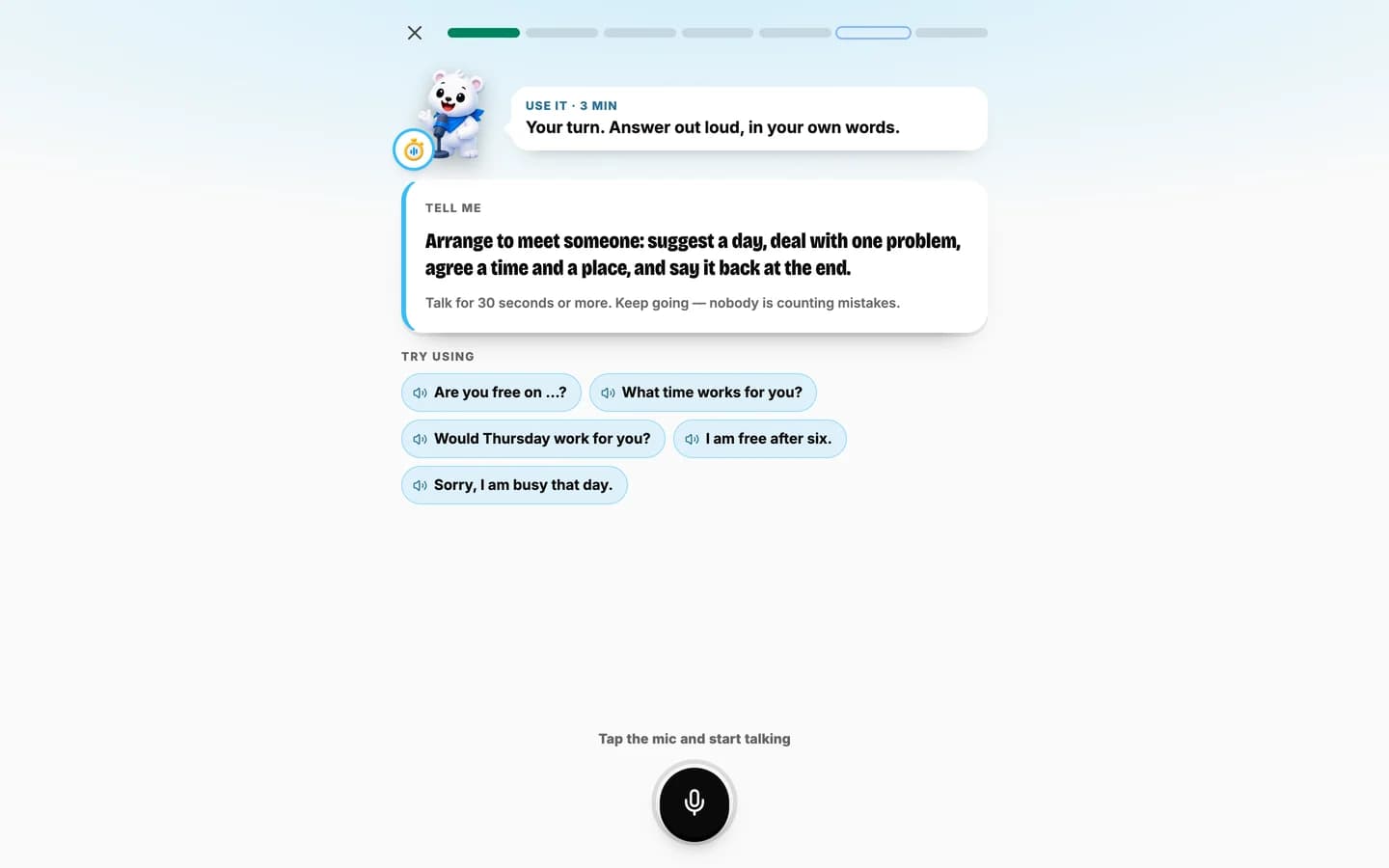 CourseA course where every step is spoken109 units from A1 to C2. Each step is a real task you say out loud, not tiles to tap.
Habits that keep confidence growing
The four weeks give you a start. These habits help you keep going afterwards:
| Item | Value (%) |
|---|---|
| 20 min | 47.2 |
| 1 h | 37.3 |
| 9 h | 27.6 |
| 1 day | 31.7 |
| 2 days | 23 |
| 6 days | 16.8 |
| 31 days | 4.1 |
A modern replication of Ebbinghaus measured how much faster a list could be relearned after each delay. Most of the benefit is gone within a day or two unless the material is used again, which is why a daily return to speaking matters more than a long session once a week.
Source: Murre & Dros (2015) One adult learning nonsense syllables; "savings" is the share of relearning time saved, not the share remembered.
- Keep speaking a little every day. Confidence fades without practice, in the same way it grows with it.
- Choose how much correction you get. On days when you feel fragile, focus only on mistakes that stop people understanding you. When you feel strong, ask for more detail.
- Work on one thing at a time. One sound, one grammar pattern or one habit, such as filler words, for a week. Small targets are easier to hit.
- Aim to be understood. Clear speech with an accent is good English. You do not need to sound like anyone else.
- Record yourself once a month. A monthly recording of the same question turns progress from a feeling into something you can hear.
Common setbacks, and what to do
"I had a bad conversation and now I feel worse." Everyone has these. One difficult conversation does not erase weeks of practice. Go back to the easier practice from week one for a few days, then pick up where you left off.
"I have stopped improving." Progress in speaking often comes in steps rather than a smooth line. Change one small thing: a new topic, a harder situation, or a different kind of feedback.
"I am worried about my accent." Everyone has an accent. Focus on the few sounds that cause real misunderstandings, rather than trying to change everything about how you speak.
"I freeze when someone I know is listening." Speaking in front of colleagues, friends or family can feel harder than speaking to a stranger, because their opinion matters more to you. Rehearse with an AI partner or on your own first, then start with one short, prepared sentence in front of that person, such as a question you have already practised.
"I do not have time." Five minutes counts. Describe your morning out loud while you get ready, and that is a full practice session.
How to tell you are becoming more confident
Confidence can be hard to see from the inside. These are the signs to watch for:
- You start speaking sooner after a question
- Your pauses are shorter, or filled with phrases instead of silence
- You use fewer filler sounds like "um" and "uh"
- You recover from a mistake and keep going instead of stopping
- Your answers get longer without feeling harder
- You say yes to conversations you would once have avoided
None of these require perfect English. They are signs that speaking English is becoming a normal part of your life.
Start today
You do not need to wait for a quiet week. Record your sixty-second starting point now, or take the free English speaking test to get an estimate of your level. If fear of speaking is what holds you back most, our guide on why speaking English feels scary, and what helps is a good companion to this plan, and the guide to speaking English with confidence brings everything together.
References
- Cepeda, N. J., Pashler, H., Vul, E., Wixted, J. T., & Rohrer, D. (2006). Distributed practice in verbal recall tasks: A review and quantitative synthesis. Psychological Bulletin, 132(3), 354-380. doi.org/10.1037/0033-2909.132.3.354 Checked 2026-09-26.
- Murre, J. M. J., & Dros, J. (2015). Replication and analysis of Ebbinghaus' forgetting curve. PLOS ONE, 10(7), e0120644. doi.org/10.1371/journal.pone.0120644 Checked 2026-09-26.