




Key findings
In brief
- Stimuler is best for iELTS candidates who want a band number after every mock. Speakle is best for learners who want confident everyday speech, with the exam as one stop on the way.
- Where Stimuler is strong: Detailed analysis of each answer, and a number for exam candidates.
- Where it puts its weight: Stimuler puts its weight on the single answer and the analysis it earns: a call, a close breakdown, the next topic.
- The research: speaking improves by producing language, not only recognising it; the figures below show what the published studies measured.
- Sources: 10 references, including Stimuler's own public pages, checked 2026-09-26.
Our verdict
The short answer
Speakle turns practice for one test into confidence for every conversation after it. You get a scored speaking session every day on the free plan, IELTS practice with a live video coach on paid plans, mistakes brought back until they stop, and real learners to talk to on video. Stimuler is a focused AI speaking coach with a strong IELTS mock; Speakle is the wider road to speaking with ease.

- Stimuler is best for
- IELTS candidates who want a band number after every mock
- Speakle is best for
- Learners who want confident everyday speech, with the exam as one stop on the way
Looking for a Stimuler alternative?
People looking for a Stimuler alternative usually like talking to an AI coach and want more around it. Speakle is free to start and gives you that: a scored session every day, a live video coach on paid plans that runs interviews, debates, travel and IELTS practice with a report for each, a course from A1 to C2, and other learners at your level on real video calls. Every explanation can come in your own language, and every mistake stays on your list until it is gone.
Stimuler and Speakle side by side
7 things people compare, answered for each.
 Speakle
Preparing for an exam? The free speaking test scores one answer on five skills with a level estimate, in about a minute and with no account.
The research: Stimuler, feature by feature
We read Stimuler's own website, help pages and app listings and wrote down what it publicly offers on each of the lines a speaking learner cares about. Each line links to the page it came from. Where we could not find a public statement the table says so, rather than guessing.
What Stimuler and Speakle each offer, feature by feature
| Feature | Stimuler | Speakle |
|---|---|---|
| How you practise speaking | 60-second impromptu speeches on set topics with instant feedback, plus scenario-based and themed speaking practice across 100+ topics. [5] | Every session is spoken: you answer in your own words, and a live AI coach holds whole conversations with you. |
| AI conversation | Voice conversations with an AI coach called Sarah on 100+ topics. Which plan includes these calls is not stated; premium is described as adding a tailored practice roadmap and 15+ full-length IELTS Speaking mock tests. [6] | A scored speaking session every day on the free plan; on paid plans, a live AI video coach for interviews, debates, travel, IELTS practice and open conversation. |
| Pronunciation feedback | Feedback on pronunciation, fluency, grammar and vocabulary after each speech, plus filler words, pace and pauses. [5] | Every sound scored with rhythm and intonation, on a path ordered by your first language, then checked in your own unplanned speech. |
| Course structure | A day-wise learning roadmap; Stimuler says it works best for learners at roughly CEFR A2 or above. No full A1-C2 course is described. [7] | A course of 109 units from A1 to C2, where every step is a task you say out loud. |
| Human teachers | Not stated publicly | No tutors to book. Schools and teachers can run their classes on Speakle. |
| Other learners | Not stated publicly | Video conversation matches you with another learner at your level for about ten minutes, then coaches you both. |
| Help in your own language | Not stated publicly | Hints, corrections and explanations in Arabic, Hindi, Japanese, Korean, Malay, Thai, Vietnamese, Turkish or Portuguese. |
| Exam preparation | IELTS Speaking focus: live video mock IELTS tests with an AI interviewer, band-score estimates and 15+ full-length mock tests (premium); TOEFL mentioned as a use case. [5] | IELTS speaking practice under exam conditions with the live coach, with a report for each part (an estimate, not an official score). |
| Free access | Free to download with free features for everyone; a premium tier unlocks more. Stimuler's own blog says the free version has limited daily sessions. [5] | A free plan with one scored speaking session every day, with no card. |
| Languages taught | English only. [8] | English only. |
| Where it runs | Android and iOS/iPadOS apps (App Store listing also lists Mac with Apple silicon and visionOS compatibility); Stimuler's blog says it is also available on web. [7] | Web, with iPhone and Android apps in early access. |
Stimuler: read on its own public pages, checked 2026-09-26. Features change; the numbered sources show where each line came from. No prices are listed because they vary by country and change often.
If an IELTS date is on your calendar, the two fit together neatly.On using Stimuler and Speakle together
Which one should you choose?
Choose Stimuler if
Your exam date is close, an instant IELTS band estimate after every mock is the thing you want most, and you are happy practising only with an AI coach, in English, for now.

Choose Speakle if
You want your speaking to reach well past the exam. Speakle gives you a scored session every day on the free plan with a CEFR estimate, runs IELTS practice with a live video coach on paid plans and reports it part by part, keeps every mistake until you have said it right three times unprompted, and then gives you real learners at your level to talk to on video, with explanations in nine native languages whenever you want them.
Start with the free speaking test, which needs no account. Then create a free account: the free plan includes a scored speaking session every day, with no card, and the first one takes five minutes.
What Stimuler is, and what it does well
What Stimuler is
Stimuler is an English-only AI speaking coach. You practise through voice calls with an AI coach on more than a hundred topics, including scenarios for interviews, meetings and travel, follow a day-wise roadmap, and can sit an IELTS mock test with an AI interviewer that returns an instant band estimate.
What Stimuler is genuinely better at
Detailed analysis of each answer, and a number for exam candidates. After you speak, Stimuler breaks the answer down closely: pronunciation at the level of single words, fluency, grammar, vocabulary, filler words and pace. Its mock test gives an instant band estimate, and for someone counting the weeks to an exam date, a number to chase is genuinely motivating. It is a focused, low-cost speaking tool that a very large community of learners already uses.
Where its design puts its weight
Stimuler puts its weight on the single answer and the analysis it earns: a call, a close breakdown, the next topic. That is a clear loop, and it keeps the work between you and one AI coach. Where tools in this class differ is what happens beyond the answer: whether a mistake from Monday is carried into the topic you pick on Friday, whether there are real people to try your English on, and whether a rule can be explained in the language you think in. Worth checking each of those against what you need.
What you get with Speakle
- 109course units, A1 to C2
- 112word collections
- 49grammar chapters, explained in your language
- 12world accents to train your ear
- 9native languages for explanations
One course, every level
| Item | Value (h) |
|---|---|
| A1 | 90 to 100 |
| A2 | 180 to 200 |
| B1 | 350 to 400 |
| B2 | 500 to 600 |
| C1 | 700 to 800 |
| C2 | 1,000 to 1,200 |
Cambridge English estimates that each level takes roughly another two hundred hours of guided learning. The hours vary with the learner and with how much they practise between lessons, which is why a little speaking every day matters more than an occasional long session.
Source: Cambridge English (2026) Cambridge describes these as a guideline only.
IELTS practice in Speakle is run by the live AI video coach on paid plans, through Part 1, Part 2 and Part 3 in order. The report then goes part by part and shows how you built each answer, and it marks each IELTS criterion as either shown in the report or needing your voice. It gives no band on purpose, because a transcript cannot fairly judge pronunciation or grammar. That judgement comes from your daily scored sessions, which do hear your voice and show a level estimate alongside it. Between the two, every mistake is kept as a rule and waits for you on a topic you did not choose, which is exactly how the real test will feel.
Speakle · the English practice app for fluency and confidence
One app for everything that gets you speaking
Most apps train one piece: words, sounds or a chat window. Speakle puts the whole road to fluent, confident English in one place, and every part of it ends with you speaking.
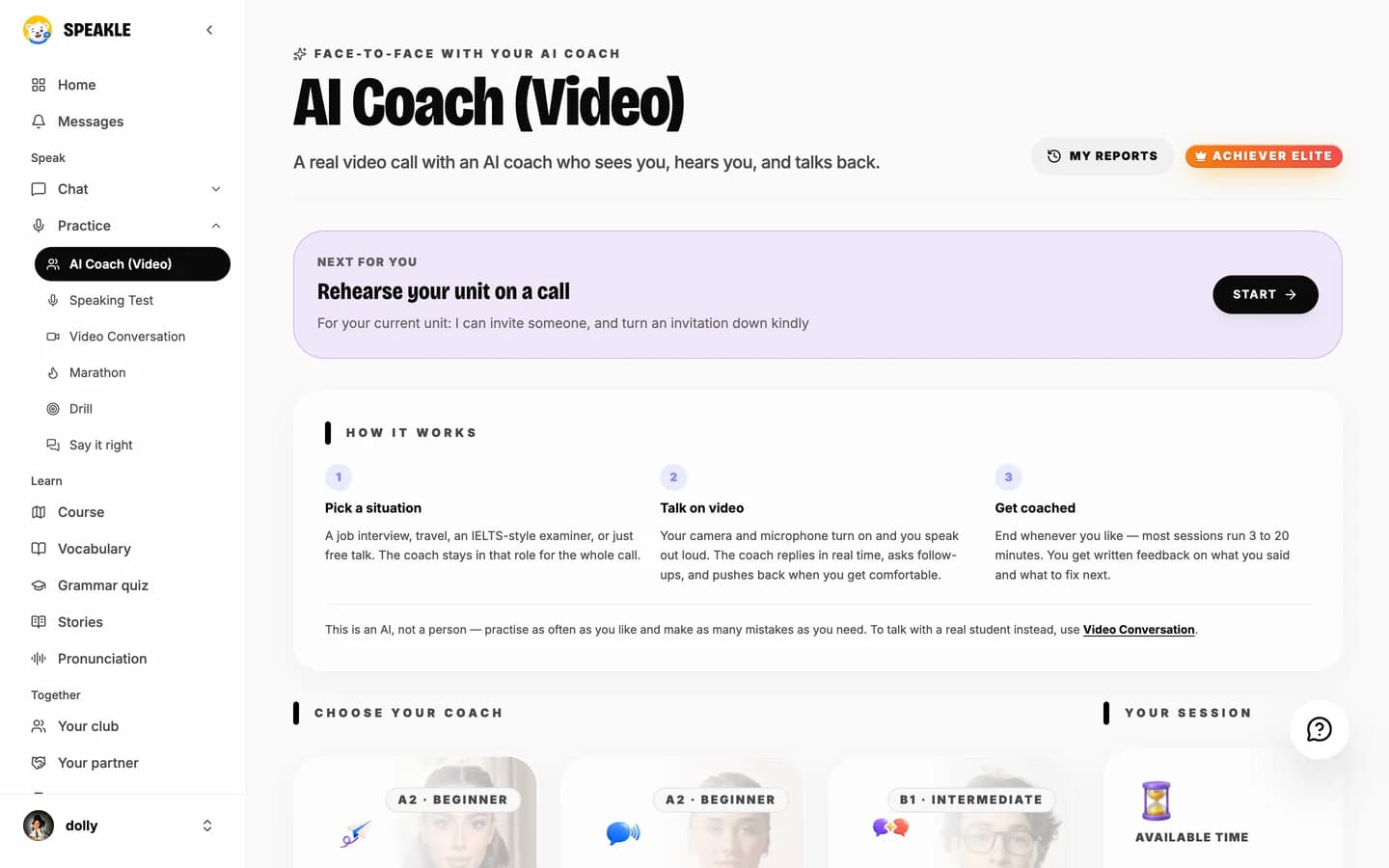 Live coachFace to face with an AI coach, on videoJob interviews, debates, travel, IELTS speaking or an open conversation. The coach stays in role for the whole call and nothing is scripted.
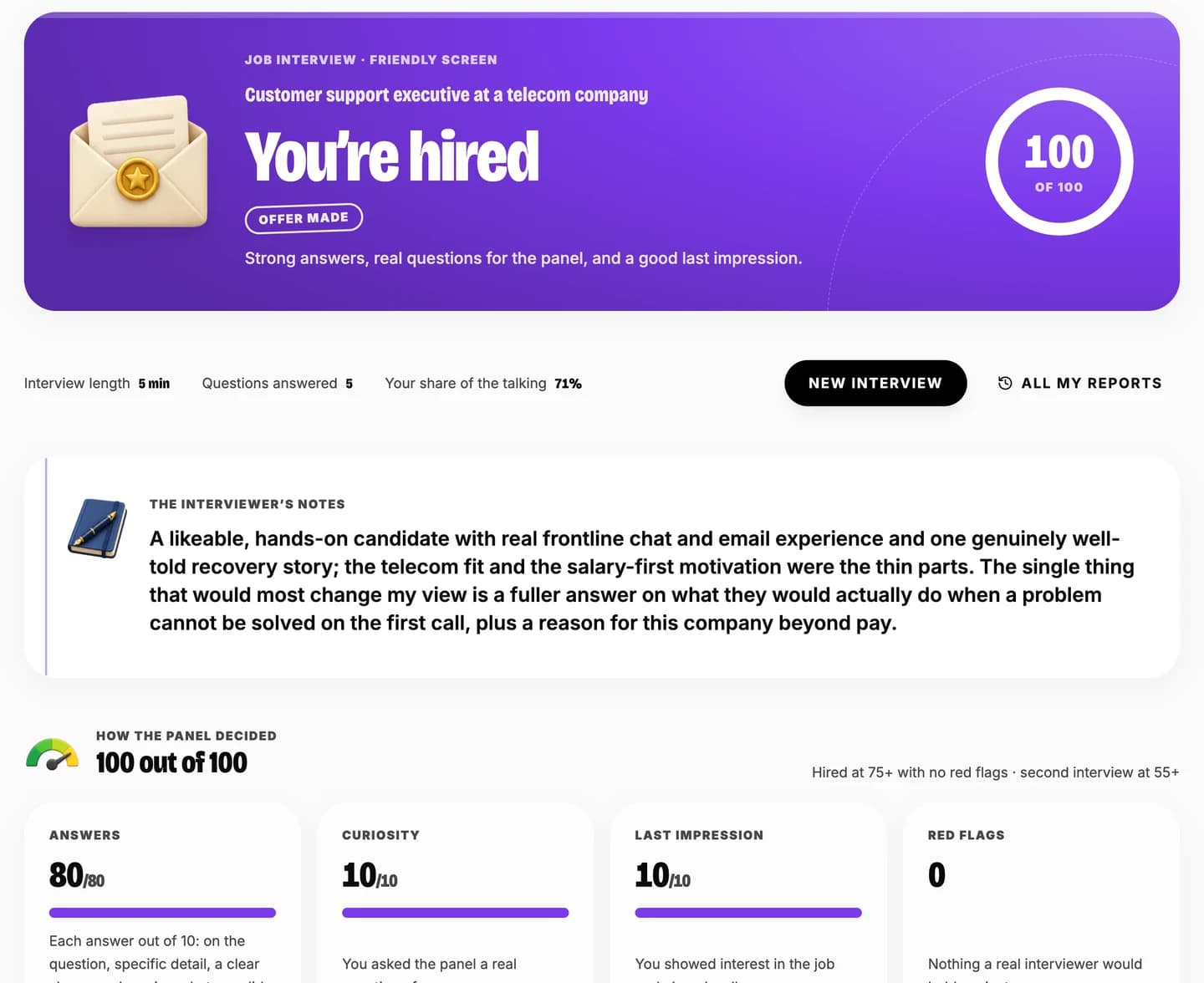 ReportsA report after every callAn interview ends in a hiring decision, a debate is won or lost, a trip earns a stamp at each stop.
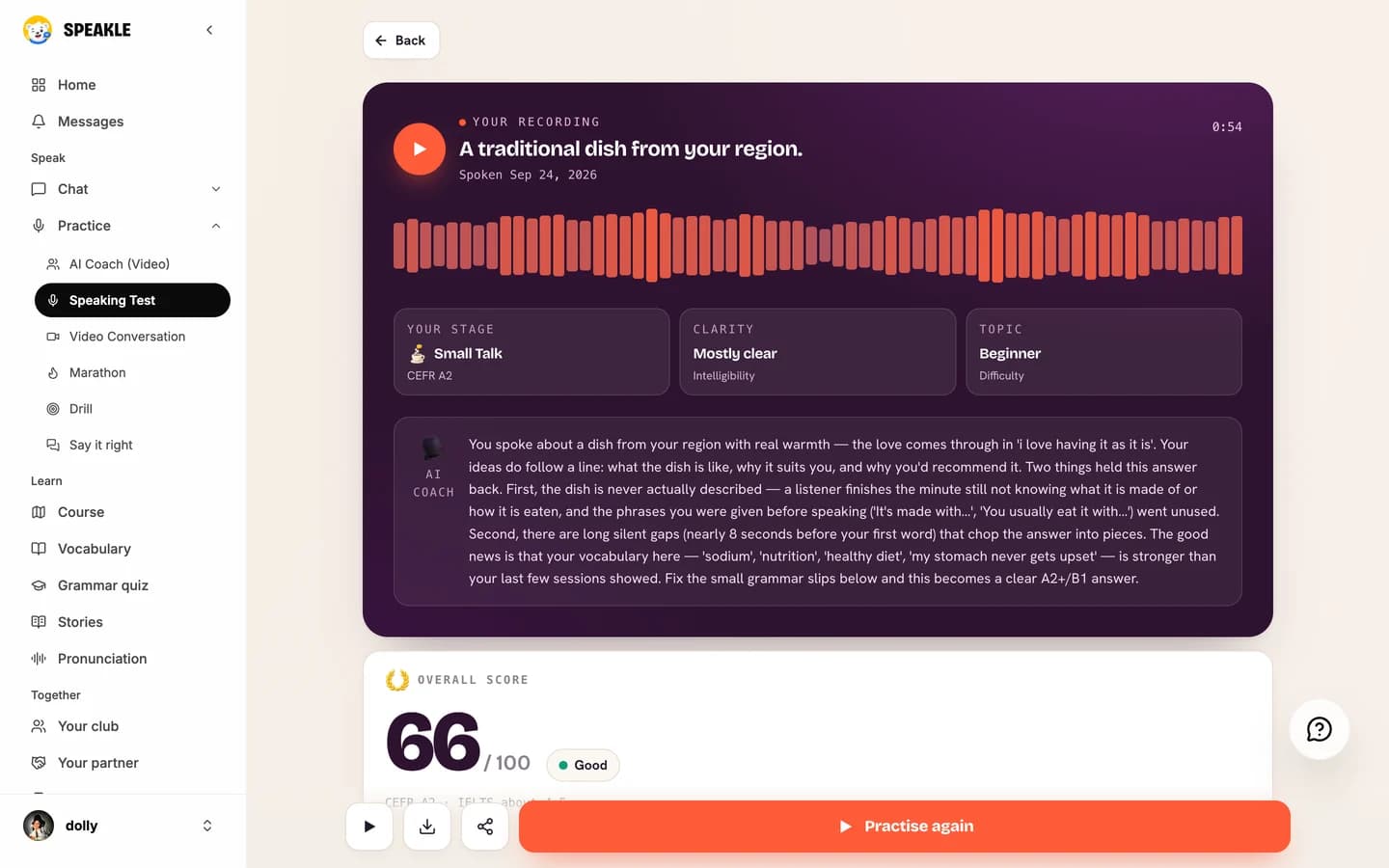 Every sessionYour speaking, measuredPronunciation, fluency, grammar, vocabulary and coherence, with a CEFR level and the one thing to fix first.
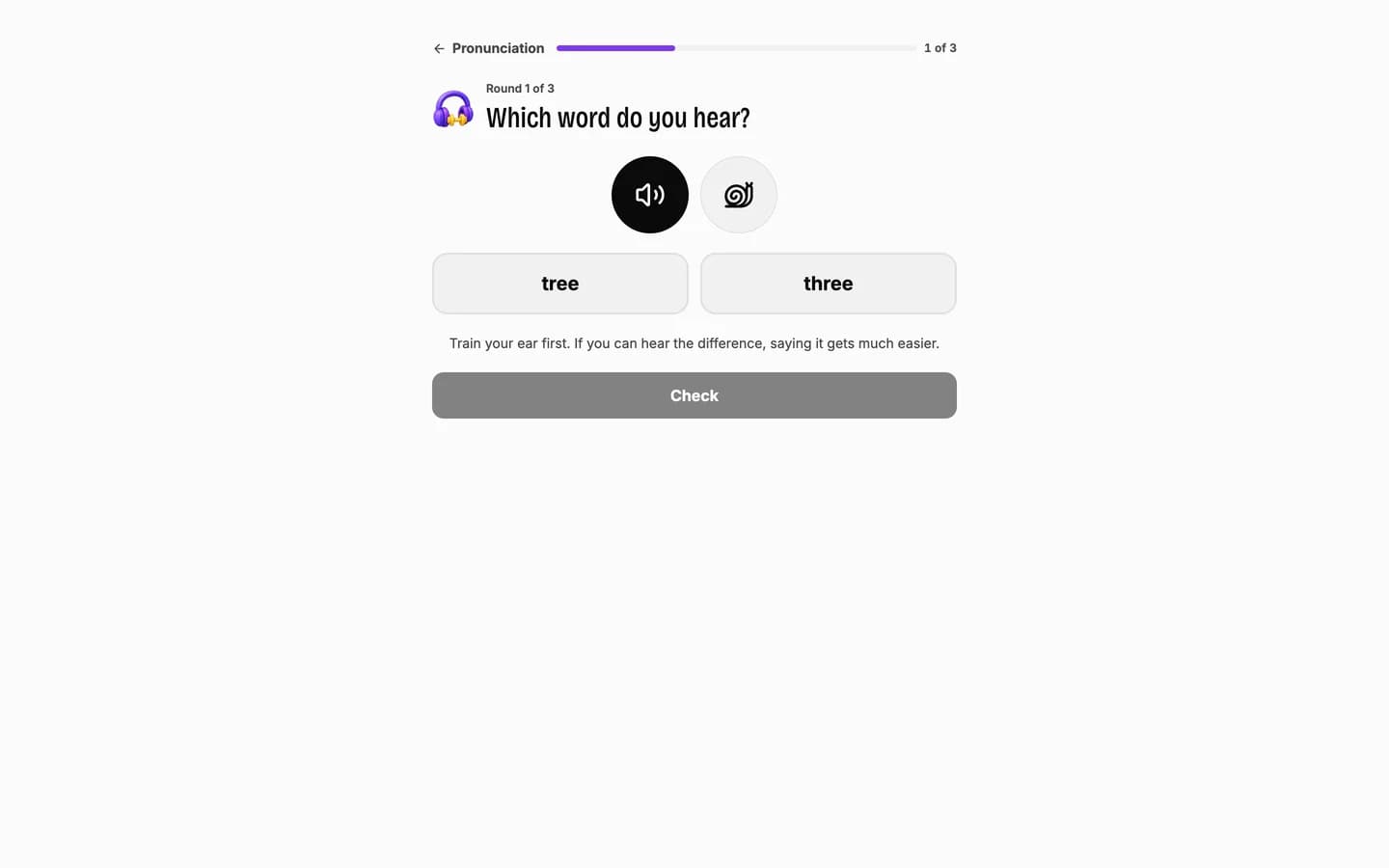 PronunciationPronunciation from your first languageSounds your language merges come first; sounds it already gives you are skipped.
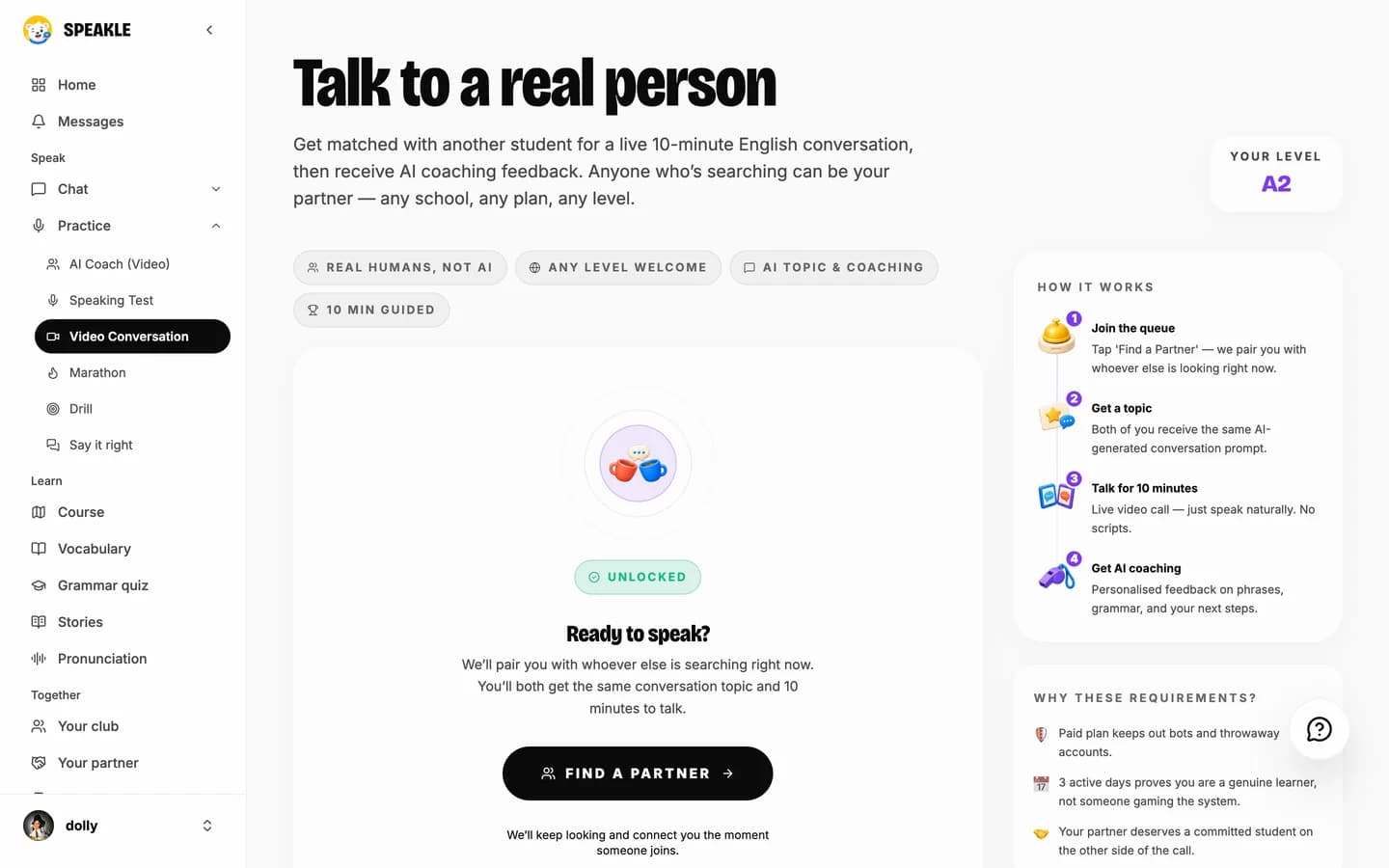 PeopleReal learners, on videoTen minutes with another learner at your level, then coaching on what you both said.
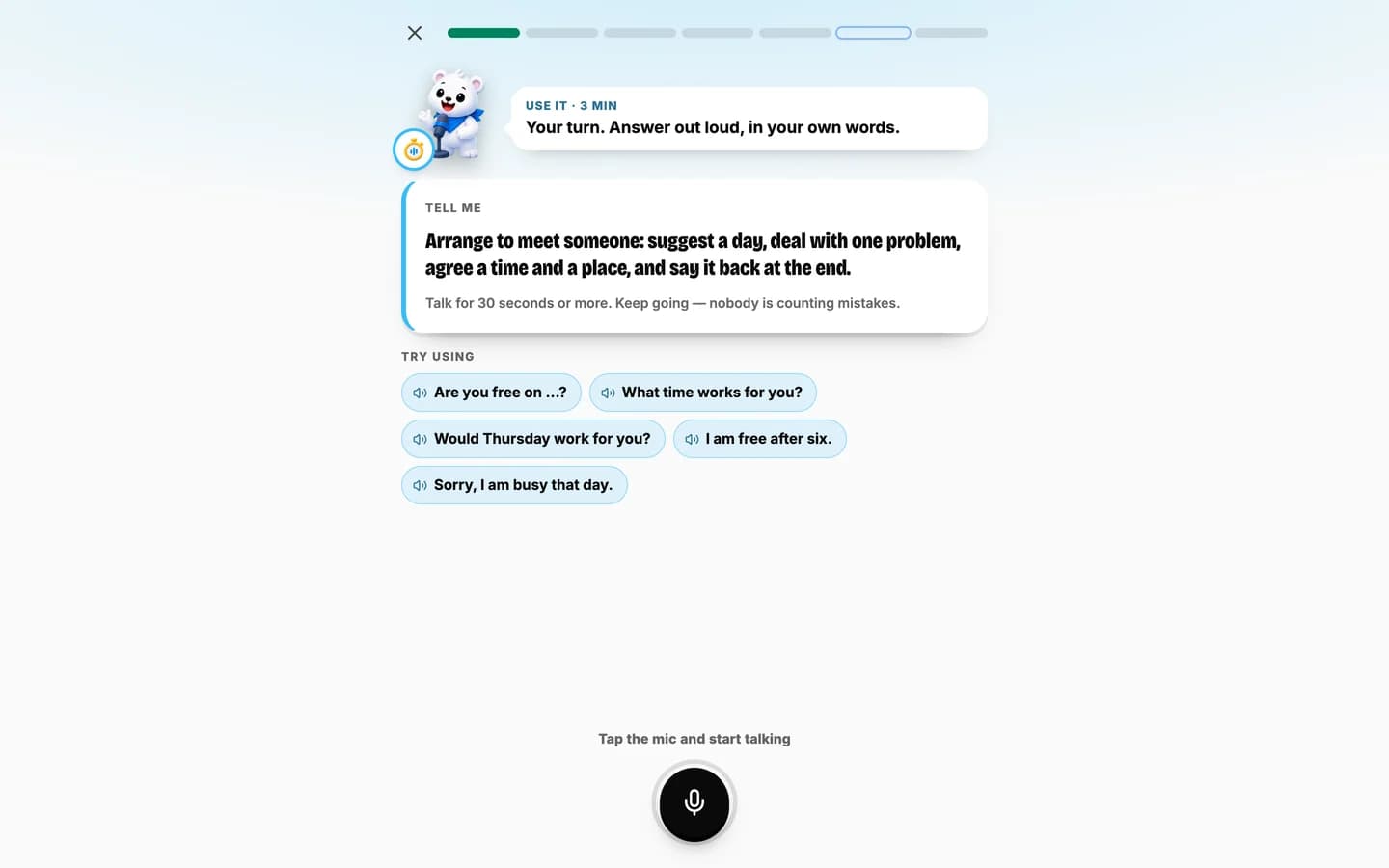 CourseA course where every step is spoken109 units from A1 to C2. Each step is a real task you say out loud, not tiles to tap.
Using Stimuler and Speakle together
If an IELTS date is on your calendar, the two fit together neatly. Use Stimuler’s mock test when you want a band estimate to measure yourself against, and use Speakle for the daily work that moves that number: a scored minute of speech every day, the mistakes it finds brought back on topics you did not choose, and live IELTS practice with a coach who reports how you built each answer in Part 1, Part 2 and Part 3. After the exam, Speakle keeps going, because the goal was never only the band. It was speaking English with people.
The short version of the argument
Recognising
- Tap the right option
- Match the pairs
- Repeat a sentence you were given
What most practice trains
Producing
- Find the words yourself
- Say them out loud
- While someone waits for you
What speaking needs
Recognising the right answer and producing it are different skills, and most practice trains the first. Tapping the right option, matching pairs and repeating a sentence you were given can all be done without finding a single word yourself, which is why people who understand English well still freeze when they have to speak it. We call this the recognition trap. The way out is spoken practice, short and daily, answered in your own words. The full explanation, with the memory research behind it, is its own page.
| Item | Condition | Value (%) |
|---|---|---|
| After 5 minutes | Read once, recalled 3 times | 71 |
| After 5 minutes | Read 3 times, recalled once | 78 |
| After 5 minutes | Read 4 times | 83 |
| After 1 week | Read once, recalled 3 times | 61 |
| After 1 week | Read 3 times, recalled once | 56 |
| After 1 week | Read 4 times | 40 |
Students who reread a passage four times remembered the most after five minutes, and the least a week later. Students who read it once and then tried to recall it three times forgot far less. Pulling words out of your own memory, which is what speaking asks of you, is what made them last.
Source: Roediger & Karpicke (2006) Experiment 2: university students recalling prose passages; share of idea units recalled.
| Item | Value (%) |
|---|---|
| Read aloud | 76 |
| Read silently | 59.8 |
| Never shown (wrongly recognised) | 21.9 |
The same people read some words aloud and some silently. Afterwards they recognised the words they had said aloud clearly more often. Saying something makes it more memorable than only seeing it, one reason spoken practice beats silent tapping for anything you want to say later.
Source: MacLeod et al. (2010) Experiment 1, 44 university students. The benefit appeared when each person read some words aloud and some silently.
| Item | Value (%) |
|---|---|
| 20 min | 47.2 |
| 1 h | 37.3 |
| 9 h | 27.6 |
| 1 day | 31.7 |
| 2 days | 23 |
| 6 days | 16.8 |
| 31 days | 4.1 |
A modern replication of Ebbinghaus measured how much faster a list could be relearned after each delay. Most of the benefit is gone within a day or two unless the material is used again, which is why a daily return to speaking matters more than a long session once a week.
Source: Murre & Dros (2015) One adult learning nonsense syllables; "savings" is the share of relearning time saved, not the share remembered.
Questions people ask
Is Speakle a good Stimuler alternative?
Yes, especially if you want more than one voice to practise with. Speakle gives you a scored speaking session every day on the free plan, a live AI video coach on paid plans for interviews, debates, travel and IELTS, a course from A1 to C2, and real learners to talk to on video. Every correction can be explained in your own language.
Which is better for IELTS speaking practice?
If an instant band number after every mock is what you want, Stimuler is built around it. Speakle takes a different view: its IELTS report goes part by part and shows how you built each answer, and it gives no band from a transcript on purpose, because grammar and pronunciation need your voice to be judged fairly. Your daily scored sessions, which do hear your voice, carry the estimate.
Can I use Stimuler and Speakle together?
Yes. A mock test with a band estimate in one, and in the other daily spoken practice, real people, and mistakes that keep coming back until they stop.
More comparisons
 business English coach
Speakle vs Loora
Looking for a Loora alternative? Speakle rehearses your real interview, ends live video interviews with a hiring decision and has a free daily AI session.Read the comparison avatar tutor
Speakle vs Praktika
Looking for a Praktika alternative? Speakle adds a report for every call, mistakes brought back until they stop, a full course and real learners on video.Read the comparison gamified course
Speakle vs Duolingo
Looking for a Duolingo alternative for speaking? Speakle is a free AI English speaking app: every session is spoken, scored and explained in your language.Read the comparison



Where to go next
References
- Cambridge University Press & Assessment. (2026). Guided learning hours. Cambridge English Support Site. support.cambridgeenglish.org/hc/en-gb/articles/202838506-Guided-learning-hours Checked 2026-09-26.
- Roediger, H. L., III, & Karpicke, J. D. (2006). Test-enhanced learning: Taking memory tests improves long-term retention. Psychological Science, 17(3), 249-255. doi.org/10.1111/j.1467-9280.2006.01693.x Checked 2026-09-26.
- MacLeod, C. M., Gopie, N., Hourihan, K. L., Neary, K. R., & Ozubko, J. D. (2010). The production effect: Delineation of a phenomenon. Journal of Experimental Psychology: Learning, Memory, and Cognition, 36(3), 671-685. doi.org/10.1037/a0018785 Checked 2026-09-26.
- Murre, J. M. J., & Dros, J. (2015). Replication and analysis of Ebbinghaus' forgetting curve. PLOS ONE, 10(7), e0120644. doi.org/10.1371/journal.pone.0120644 Checked 2026-09-26.
- Stimuler, public page at play.google.com. play.google.com/store/apps/details?id=com.stimuler&hl=en_US&gl=US Checked 2026-09-26.
- Stimuler, public page at stimuler.tech. stimuler.tech Checked 2026-09-26.
- Stimuler, public page at stimuler.tech. stimuler.tech/blog/speak-vs-stimuler-2026 Checked 2026-09-26.
- Stimuler, public page at stimuler.tech. stimuler.tech/blog/busuu-vs-stimuler-which-app-builds-english-fluency-faster Checked 2026-09-26.
- Stimuler, public page at inc42.com. inc42.com/buzz/stimuler-bags-3-75-mn-to-strengthen-its-ai-led-english-tutor Checked 2026-09-26.
- Stimuler, public page at apps.apple.com. apps.apple.com/us/app/id1627501632 Checked 2026-09-26.