
What English speaking anxiety is
Language teachers and researchers have a name for this feeling: foreign language anxiety. It describes the worry and tension that can come up when you use a language you are still learning. It tends to be strongest when you have to speak, because speaking happens in front of other people and in real time.
| Item | Value (%) |
|---|---|
| Panic when speaking without preparation | 49 |
| Do not feel confident when speaking | 47 |
| Get nervous and confused when speaking | 33 |
| Self-conscious speaking in front of others | 28 |
In the study that introduced the Foreign Language Classroom Anxiety Scale, about half of the students said they panic when they have to speak without preparation. Freezing when you speak is common, and it is about the situation, not about how much you know.
Source: Horwitz, Horwitz & Cope (1986) A pilot group of 75 university students of Spanish in the United States.
It shows up at every level. Beginners feel it, and so do people with years of study, good exam results and jobs that use English every day. Being anxious about speaking says little about how much English you know. It says much more about how speaking English has felt for you so far.
Why it happens, even when you know the language
Your attention gets split
Speaking asks a lot of your mind at once. You are listening, deciding what you want to say, finding the words, building the sentence and pronouncing it, while also reading the other person's face and tone. When you are worried about how you sound, part of your attention goes to watching yourself. That leaves less for the job of speaking, so words you know well become harder to reach. This is why people so often say, "I knew that word, it just would not come out."
Mistakes feel public
A mistake in a written exercise stays on the page. A mistake in speech happens in front of someone. If you learned in classrooms where errors were corrected in front of everyone, or you have been laughed at for a word or for your accent, that memory stays with you. The next time you speak, your body prepares for the same thing to happen again.
The stakes feel high
Many of the moments where we need spoken English matter to us: a job interview, a meeting, a phone call to a hotel or a clinic, a first conversation with a partner's family. When a lot depends on how you come across, pressure goes up, and pressure makes freezing more likely.
You have had little safe practice
This may be the biggest reason of all. Most people get far more practice reading, writing and listening than speaking. In a busy class, each student might speak for only a minute or two. Without enough low-pressure practice, every speaking situation feels like a performance rather than an ordinary conversation.
What it can feel like
Speaking anxiety is not only a thought. It often shows up in your body and in what you do. You might notice:
- Your mind going blank, even on simple questions
- A faster heartbeat, a tight throat or a shaky voice
- Speaking quietly, or rushing to get it over with
- Rehearsing a sentence in your head until the moment has passed
- Answering in as few words as possible
- Avoiding calls, meetings or social events where English is needed
- Replaying a conversation afterwards and remembering only the mistakes
If you recognise several of these, you are in good company. They are among the most common experiences language learners describe.
What does not help much
Some advice sounds sensible but rarely makes a difference on its own.
"Just relax." Nobody relaxes on instruction. Being told to calm down often adds a second worry: now you are anxious and also failing to relax.
Waiting until you feel ready. Confidence usually comes after speaking, not before it. If you wait to feel ready, the waiting can go on for years.
Memorising whole scripts. Preparing is useful, but a word-for-word script breaks the moment the other person says something unexpected, and that can make the freeze worse.
Only studying more grammar. Grammar matters. But if the problem is pressure, more rules can make you even more focused on avoiding mistakes, and that focus is part of what slows you down.
What helps
Lower the stakes first
Start where mistakes cost nothing. Talk to yourself while you cook. Describe your route to work out loud. Record a voice note answering a question, and delete it afterwards if you like. Practise with a patient friend or an AI speaking coach. The aim at this stage is not perfect English. It is learning, through experience, that speaking English is survivable.
Speak a little, often
Short and frequent beats long and rare. Five minutes of speaking on most days builds familiarity faster than a single hour at the weekend. Each small session is one more piece of evidence that you can do this, and those pieces add up.
Prepare language, not speeches
Instead of writing out full answers, collect useful chunks: phrases you can adapt to many situations. For example:
- "The main reason is..."
- "I have been working on this for about..."
- "What I like about it is..."
- "It depends. On one hand... but on the other hand..."
- "Can I think about that for a second?"
Chunks give you something to say while your mind catches up, and they bend to fit the conversation in a way a script cannot.
Get feedback you can act on
Vague feedback such as "good job" or "work on your fluency" does not help, and a long list of corrections can make anxiety worse. Look for feedback that names one or two specific things, explains why, and does it in words you fully understand, including your first language if that helps. Then practise only those things.
It also helps to control how much correction you receive. On a nervous day, hearing only what stopped someone understanding you is enough. On a confident day, you might want every detail.
Treat mistakes as information
Every speaker makes mistakes, including people speaking their first language. The difference is what a mistake means to you. If it feels like proof that you are not good enough, each one makes the next sentence harder. If it is simply information, it tells you what to practise next and nothing more.
One practical way to shift this is to keep a short list. After a conversation or a practice session, write down one mistake you noticed and the correct version. Say the correct version out loud a few times. Over a few weeks, the list becomes a record of things you have fixed, which is a far kinder thing to look back on than a memory of feeling embarrassed.
Rehearse the hard situation before it happens
If one particular moment worries you, practise that moment. Before an interview, answer "Tell me about yourself" out loud ten times. Before a trip, practise checking in at a hotel and asking for directions. Before a family dinner, practise introducing yourself and asking a few questions about the other person. When the real conversation comes, it will not be the first time you have said those words.
Notice your progress
Anxiety has a habit of remembering mistakes and forgetting progress, so keep evidence. Record a one-minute answer today and save it. Record an answer to the same question a month from now. Most people are surprised by how different they sound, and hearing it for yourself is more convincing than anyone telling you that you have improved.
Speakle · the English practice app for fluency and confidence
One app for everything that gets you speaking
Most apps train one piece: words, sounds or a chat window. Speakle puts the whole road to fluent, confident English in one place, and every part of it ends with you speaking.
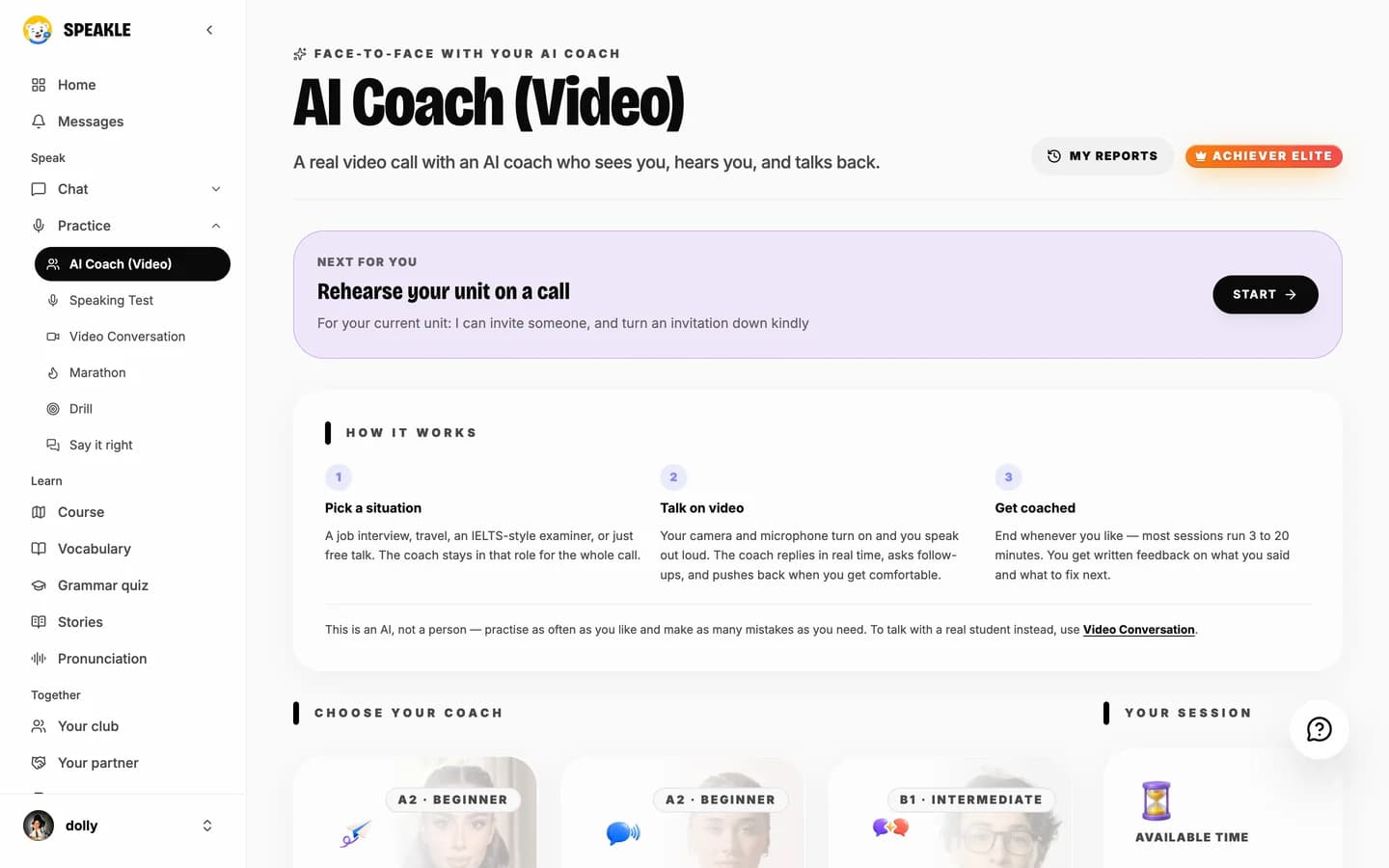 Live coachFace to face with an AI coach, on videoJob interviews, debates, travel, IELTS speaking or an open conversation. The coach stays in role for the whole call and nothing is scripted.
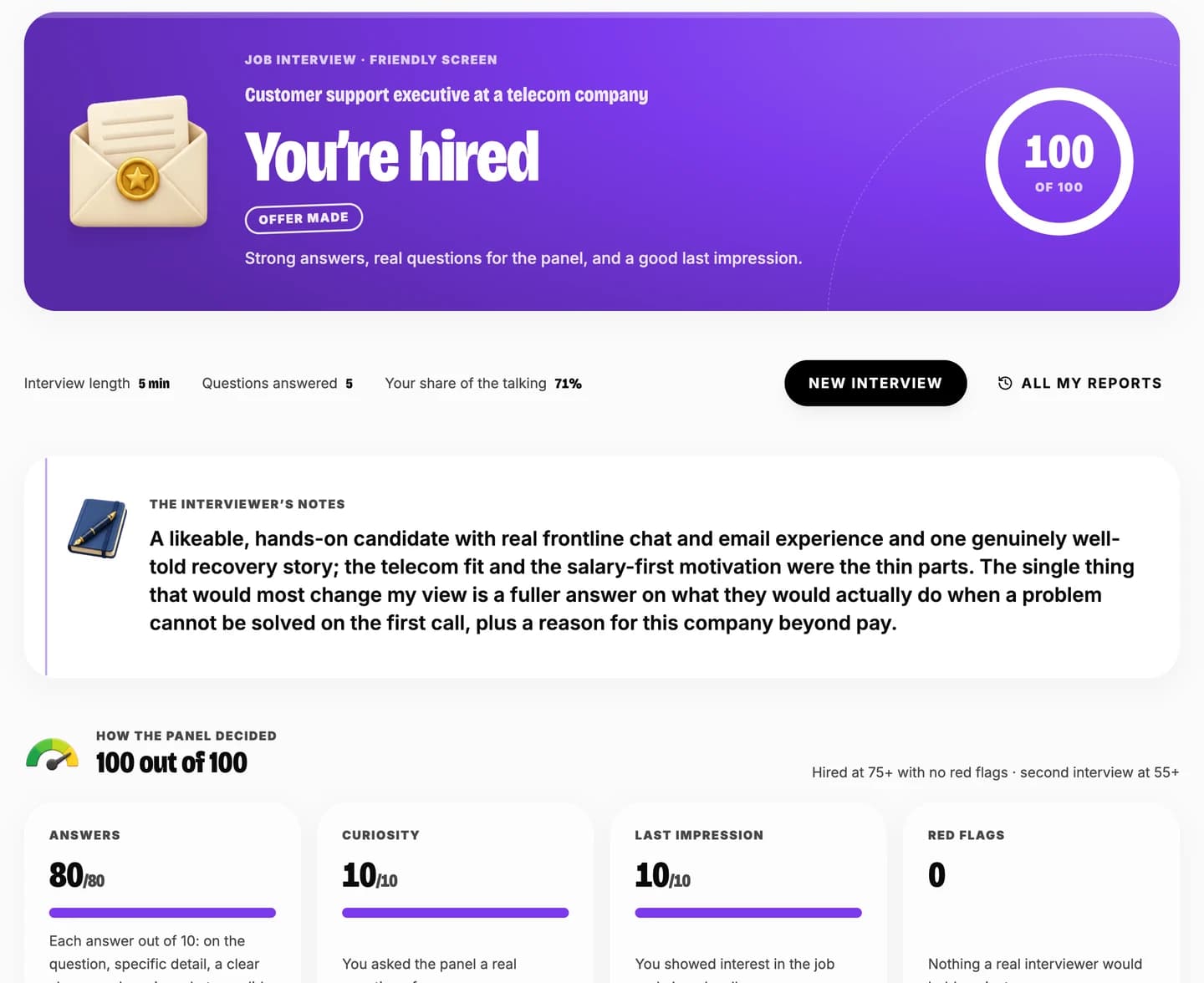 ReportsA report after every callAn interview ends in a hiring decision, a debate is won or lost, a trip earns a stamp at each stop.
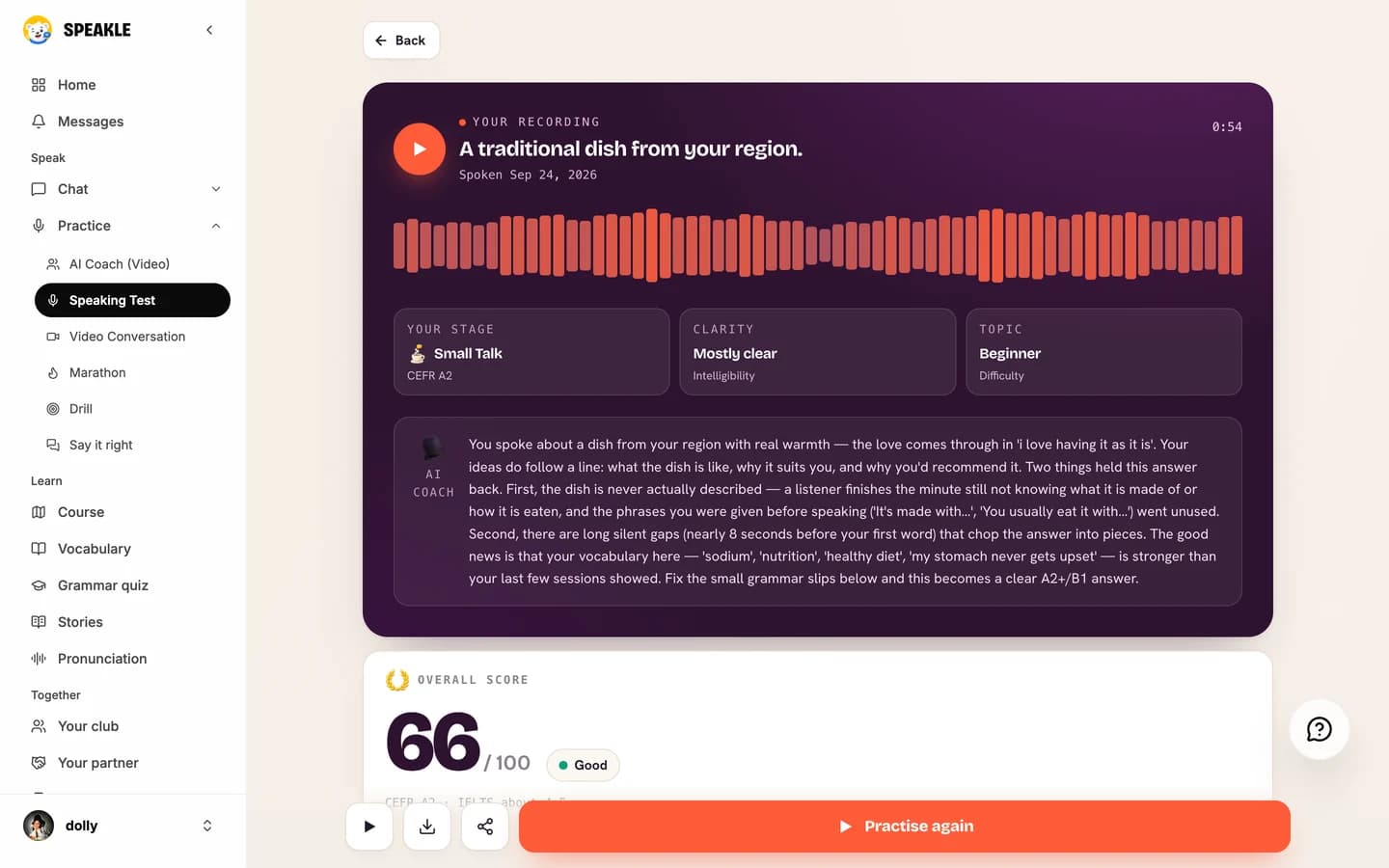 Every sessionYour speaking, measuredPronunciation, fluency, grammar, vocabulary and coherence, with a CEFR level and the one thing to fix first.
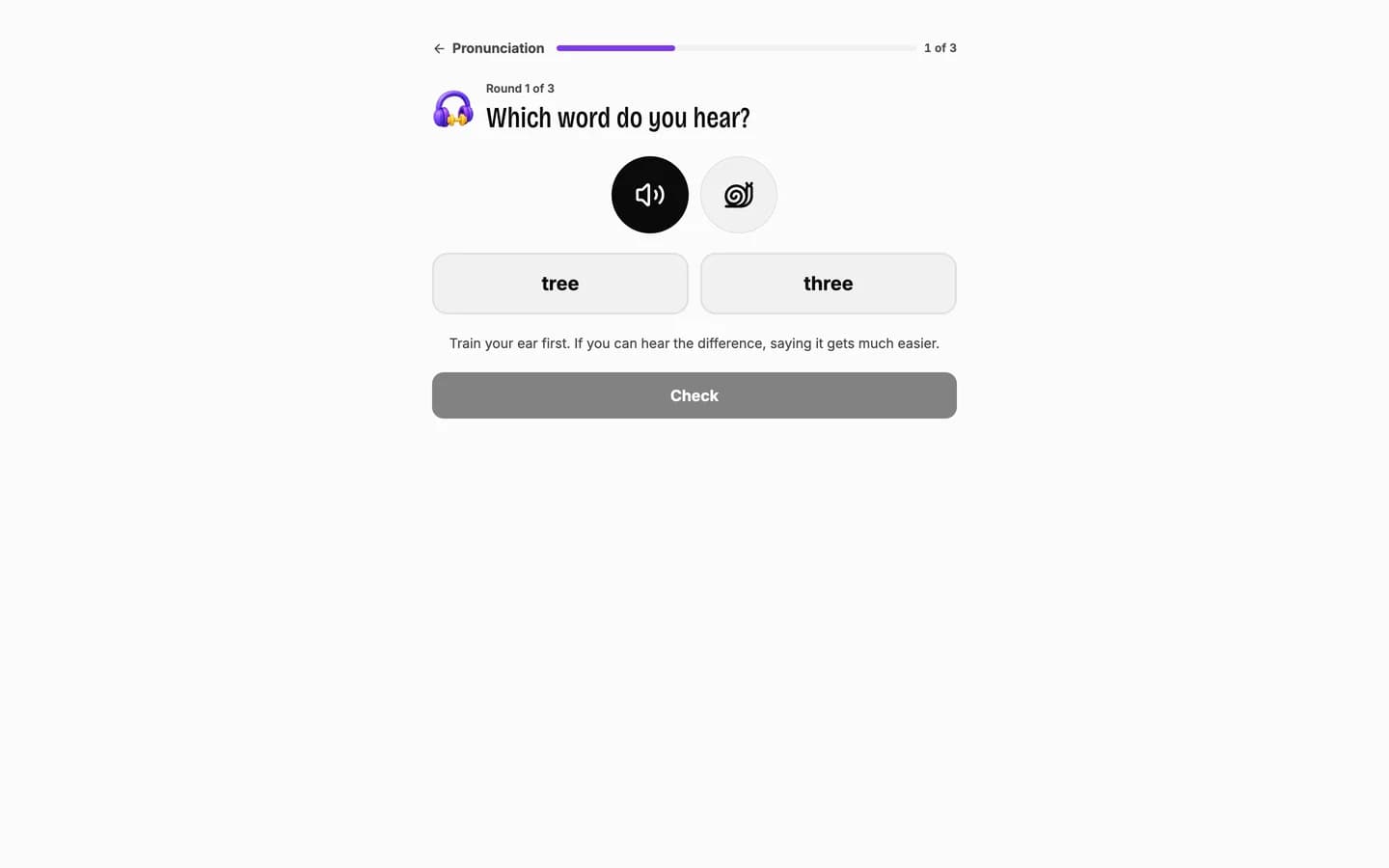 PronunciationPronunciation from your first languageSounds your language merges come first; sounds it already gives you are skipped.
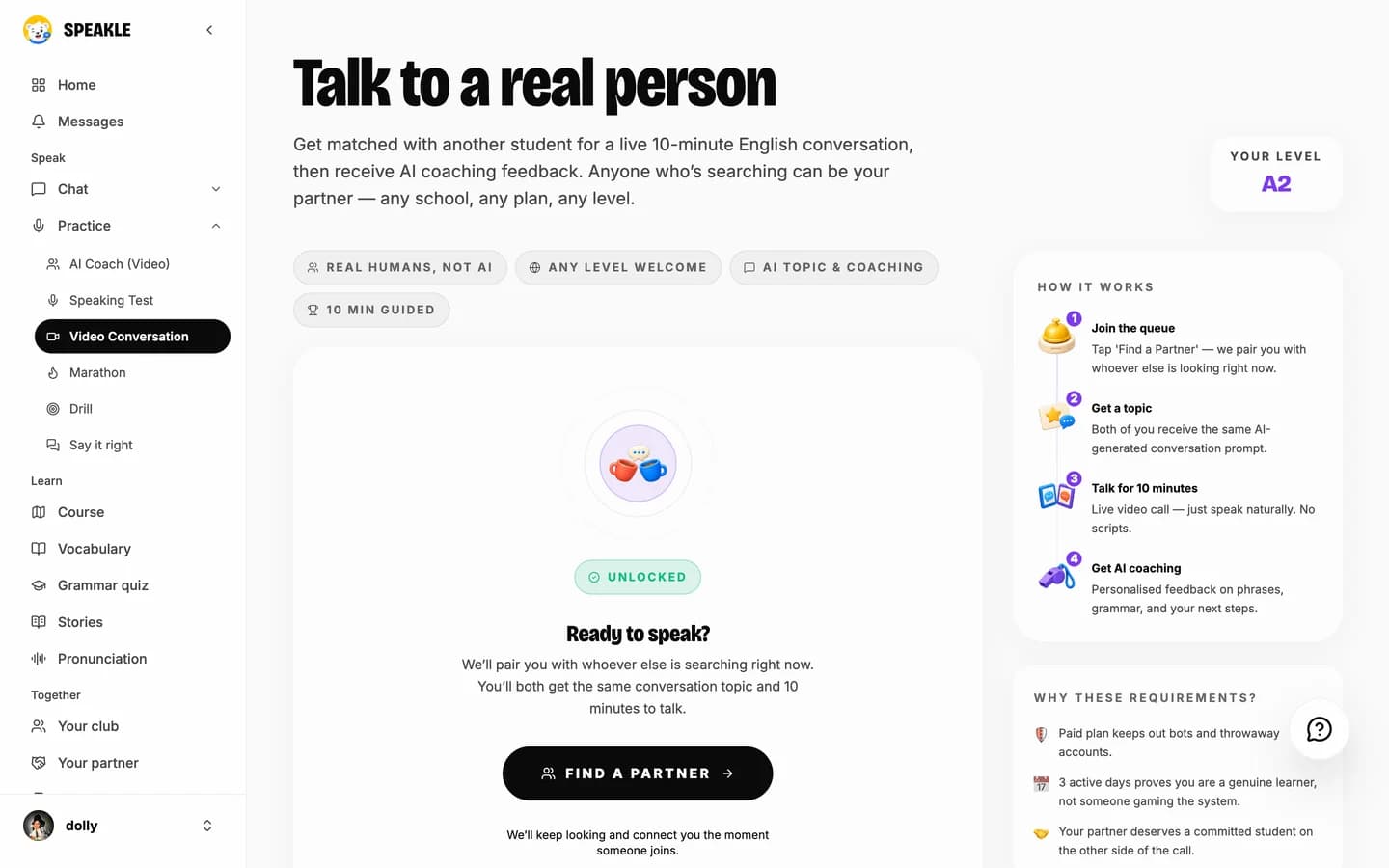 PeopleReal learners, on videoTen minutes with another learner at your level, then coaching on what you both said.
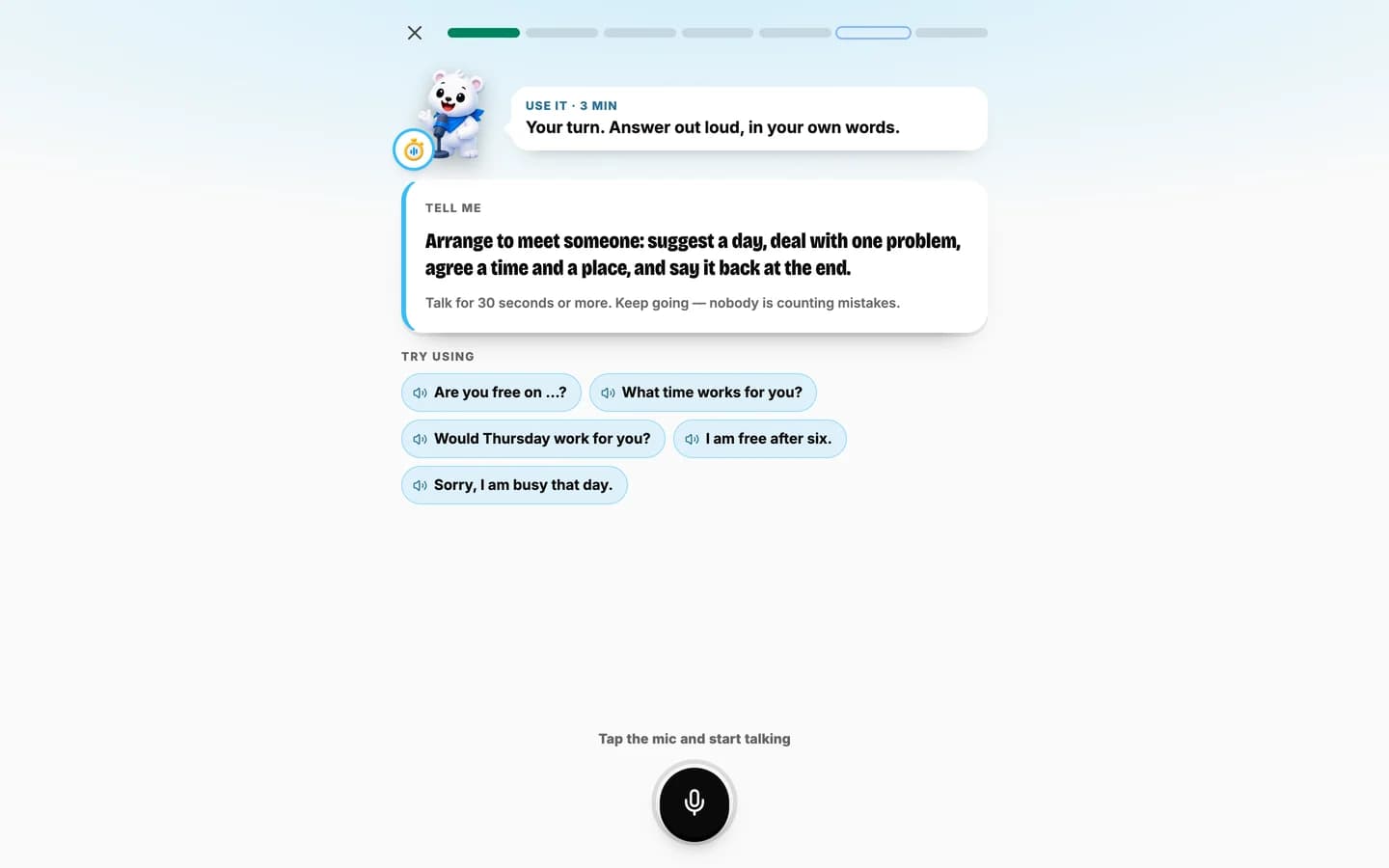 CourseA course where every step is spoken109 units from A1 to C2. Each step is a real task you say out loud, not tiles to tap.
What to do in the moment you freeze
Even with practice, you will sometimes go blank. That is normal, and it happens to people speaking their first language too. What matters is having a way to keep going. These phrases buy you time and keep the conversation open:
| When this happens | Try saying |
|---|---|
| You need a moment to think | "Let me think about that for a second." |
| You cannot find a word | "I am not sure of the word. It is a kind of..." |
| You lose your sentence | "Sorry, let me say that another way." |
| You did not understand | "Could you say that again, a bit more slowly?" |
| You said something wrong | "Sorry, I mean..." and carry on |
A few other things help in the moment:
- Slow down on purpose. A slower pace gives your mind time, and it usually makes you easier to understand, not harder.
- Breathe out before you start. A long, slow breath out helps settle a racing heartbeat.
- Aim to be understood, not to be perfect. If the other person understood you, the sentence did its job, even if the grammar was not perfect.
- Remember that most listeners are on your side. People are usually thinking about what you mean, not grading how you said it.
When it is more than nerves
For most learners, speaking anxiety is uncomfortable but manageable, and it shrinks with practice. If you find that anxiety affects many parts of your life, not only speaking English, or it keeps you from things that matter to you, it is worth talking to a doctor or a qualified mental health professional. There is nothing unusual about asking for that kind of help.
Where to start today
Pick the smallest step you can take in the next ten minutes. Answer one question out loud, for one minute, somewhere nobody can hear you. That is enough for today.
If you would like to know where you stand, the free English speaking test asks you to answer a question out loud and gives you an estimate of your level. For a longer plan, read how to build confidence speaking English, step by step, or go back to the guide to speaking English with confidence for an overview.
References
- Horwitz, E. K., Horwitz, M. B., & Cope, J. (1986). Foreign language classroom anxiety. The Modern Language Journal, 70(2), 125-132. doi.org/10.1111/j.1540-4781.1986.tb05256.x Checked 2026-09-26.