How to use these questions
Below are English speaking practice questions for every level of the CEFR scale, from A1 (beginner) to C2 (proficient). Each level has ten questions on everyday topics: work or study, family and friends, food, travel, weekends, technology, hobbies and plans. They are the kind of questions you meet in a spoken English test, in a job interview, and in ordinary conversation with someone you have just met.
For each level you will also find what a good answer sounds like at that level, a short model answer, phrases worth having ready, and one tip. The model answers are not scripts to memorise. They show the size and shape of an answer, so you can hear the difference between levels and aim one step above where you are now.
You do not need to know your level before you start. Read the A2 and B1 questions, pick one from each and answer them out loud. If one feels easy and the other feels like hard work, you have found roughly where you are. If you would like a second opinion, the free Speakle speaking test asks you one question like these and gives you an estimated level in about a minute, with no account needed.
One rule matters more than any other on this page: answer out loud. Reading a question and thinking "I could answer that" trains a different skill from saying the answer. The guide on why you understand English but freeze when you speak it explains why, but the short version is simple. Your mouth has to do the practice, not only your eyes.
What the CEFR levels mean for speaking
The CEFR (Common European Framework of Reference for Languages) describes language ability in six levels. Many courses, schools and exams around the world use it, which is why a CEFR level is a useful way to describe your speaking. In plain words, this is what each level sounds like when someone talks:
| Item | Value (h) |
|---|---|
| A1 | 90 to 100 |
| A2 | 180 to 200 |
| B1 | 350 to 400 |
| B2 | 500 to 600 |
| C1 | 700 to 800 |
| C2 | 1,000 to 1,200 |
Cambridge English estimates that each level takes roughly another two hundred hours of guided learning. The hours vary with the learner and with how much they practise between lessons, which is why a little speaking every day matters more than an occasional long session.
Source: Cambridge English (2026) Cambridge describes these as a guideline only.
| Level | What your speaking sounds like | A typical answer |
|---|---|---|
| A1 | Single words and short, memorised sentences about yourself | Two or three simple sentences |
| A2 | Simple sentences about routine, family, work and the past | Four to six linked sentences |
| B1 | Connected speech about experiences, plans and opinions, with reasons | Half a minute to a minute, with an example |
| B2 | Clear, detailed answers that compare, explain and argue a point | About a minute, organised, with few long pauses |
| C1 | Fluent, flexible speech with precise words and natural structure | A minute or more, with nuance and qualification |
| C2 | Effortless, exact speech that adjusts tone and handles abstract ideas | As long as it needs to be, never padded |
Two things are worth knowing before you start. First, level is mostly about range and control: how many kinds of sentence you can build, and how reliably. Accent is a separate thing. You can speak at C1 with a strong accent, and people do every day. Second, most people's speaking level sits below their reading level. That is normal, and it is good news, because speaking is the skill that responds fastest to practice.
A1 speaking questions (beginner)
At A1 a good answer is short, clear and about you. You use present simple sentences ("I live", "I work", "I like"), everyday words, and you can answer with a full sentence rather than one word.
- What is your name, and where do you live?
- What do you do? Do you work or study?
- Who is in your family?
- What is your favourite food?
- What time do you get up in the morning?
- What do you like doing at the weekend?
- What is your favourite day of the week? Why?
- What do you have on your phone? Which app do you use most?
- Do you like music? What kind?
- What is the weather like today?
What a good A1 answer sounds like: two or three full sentences, each with a subject and a verb. Mistakes are fine. The listener should understand you without guessing.
Model answer to "Who is in your family?":
"There are four people in my family. My mother, my father, my sister and me. My sister is a student. I love my family."
Useful phrases: "My name is...", "I live in a small town / a big city", "I work in a shop / an office / a hospital", "I like... because it is...", "I don't like...", "My favourite... is..."
Tip: add one detail to every answer. "I like rice" becomes "I like rice with vegetables." One extra detail is how an A1 answer starts to sound like A2.
A2 speaking questions (elementary)
At A2 you can talk about your routine, the people around you and things that happened in the past. A good answer links sentences with "and", "but", "because" and "then", and uses the past simple for yesterday and last week.
- Tell me about a normal day for you.
- What did you do last weekend?
- Describe your home. What is your favourite room?
- What do you usually eat for breakfast?
- Tell me about a friend you see often.
- How do you travel to work or to your place of study?
- What did you do on your last day off?
- What do you use your phone for every day?
- Where would you like to go on holiday? Why?
- What do you want to do next weekend?
What a good A2 answer sounds like: four to six sentences that follow each other in order, with a reason somewhere ("because it is quiet"). Past tense verbs are mostly right, especially the common ones: went, had, saw, ate, made.
Model answer to "What did you do last weekend?":
"On Saturday I got up late and had a big breakfast. Then I went to the market with my brother, and we bought fruit and fish. In the evening my friends came to my home and we watched a film. It was relaxing because I didn't work."
Useful phrases: "First... then... after that...", "Usually I..., but sometimes I...", "Last week I...", "It was fun / tiring / boring because...", "I would like to..."
Tip: tell it in order. When you get lost at A2, it is usually because you jumped ahead in the story. "First, then, after that" keeps you on the road and gives your brain a moment to find the next verb.
B1 speaking questions (intermediate)
B1 is where speaking starts to feel like conversation. You can describe experiences, explain your plans, give an opinion and support it with a reason and an example. You can keep talking for a minute on a familiar topic, even if you pause to find words.
- Tell me about a trip you really enjoyed. What made it special?
- Describe your job or your studies. What do you like about it, and what is difficult?
- What is a skill you would like to learn, and why?
- How do you usually spend your free time, and has that changed in the last few years?
- Tell me about a meal you remember well. Who were you with?
- Do you prefer to live in a city or in the countryside? Why?
- How has technology changed the way you talk to your family and friends?
- Tell me about a time you had a problem and solved it.
- What are your plans for the next year?
- Describe a person who has helped you. What did they do?
What a good B1 answer sounds like: about half a minute to a minute, with a clear point, a reason and an example. You use a mix of tenses (past for the story, present for how you feel now, future for plans). You notice some of your own mistakes and correct them, which is a good sign, not a bad one.
Model answer to "Tell me about a trip you really enjoyed":
"A few years ago I went to the mountains with two friends from work. We stayed in a small guesthouse and walked every day. What made it special was that we had no phone signal, so we talked much more than usual. One evening the owner cooked for everyone and we all ate together at one long table. I still think about that trip when work is stressful, because it reminded me that I don't need much to be happy."
Useful phrases: "What I liked most was...", "The main reason is...", "For example...", "In my opinion... / I think... because...", "I'm planning to... / I'm hoping to...", "It was difficult at first, but..."
Tip: use the point, reason, example shape. Say your answer in one sentence, give one reason, then one example from your life. It works for almost every B1 question and it stops you running out of things to say after two sentences.
B2 speaking questions (upper intermediate)
At B2 you can speak clearly and in detail on a wide range of topics, explain a point of view, and discuss advantages and disadvantages. You speak with enough fluency that the listener is not waiting for you, and you can handle a follow-up question you did not expect.
- Some people say working from home is better than working in an office. What do you think?
- How important is it for young people to travel before they settle down?
- Describe a change you would make to the place where you live, and explain how it would help.
- What are the advantages and disadvantages of learning something online rather than in a classroom?
- Tell me about a decision you made that turned out differently from what you expected.
- How has the way people cook and eat changed in your lifetime?
- Should children have smartphones? At what age, and with what limits?
- What makes a good manager or team leader?
- Why do you think some hobbies become popular very suddenly?
- How do you think your job, or the job you want, will change in the next ten years?
What a good B2 answer sounds like: about a minute, organised so the listener can follow it. You compare two sides before giving your view. Your grammar is mostly accurate, including conditionals ("if more people did this, it would...") and the present perfect. Pauses happen while you think about ideas, not while you search for basic words.
Model answer to "Working from home or in an office?":
"I think it depends on the kind of work. For focused tasks, like writing a report, working from home is usually better, because there are fewer interruptions and you save the time you would spend travelling. On the other hand, when a team is new or a project is complicated, being in the same room helps a lot. You pick up small things, like how a colleague solved a problem, that never get written down. So personally I would choose a mix: two or three days together, and the rest at home. That way you get the quiet time and the connection."
Useful phrases: "It depends on...", "On the one hand... on the other hand...", "The biggest advantage is..., but the downside is...", "If..., it would...", "That's why I would say...", "To give you an example..."
Tip: end with a clear conclusion. Many B2 speakers give a good balanced answer and then trail off. One closing sentence ("So on balance, I would...") makes the whole answer sound more confident and shows the listener you have finished.
C1 speaking questions (advanced)
At C1 you speak fluently and flexibly, for social, work and study purposes. You can develop an idea, qualify it, and move between the general and the specific without losing the thread. A listener hears someone thinking in English, not translating into it.
- To what extent do you think the place you grow up shapes the person you become?
- Some argue that technology has made us more connected but less close. How far do you agree?
- Describe a time you had to persuade someone who disagreed with you. How did you approach it?
- What do you think is lost, and what is gained, when a traditional skill is replaced by a machine?
- How should a workplace balance flexibility for employees with the needs of the business?
- Is it better to be very good at one thing or quite good at many things?
- Why do you think people enjoy food from other cultures so much, and does that change the food?
- How would you explain your job to a child, and what does that tell you about it?
- What responsibilities, if any, do travellers have towards the places they visit?
- Looking back, what piece of advice would you give yourself five years ago?
What a good C1 answer sounds like: one to two minutes of well-organised speech with precise vocabulary ("a trade-off", "on reflection", "it's not so much X as Y"). You qualify your views instead of stating them flatly, and you use a range of structures naturally. Errors are rare and usually small, and you tend to correct them as you go.
Model answer to "Very good at one thing, or quite good at many?":
"My instinct is to say depth, because the people I most admire at work are the ones who know one area inside out. But on reflection, I think it's less a choice than a sequence. Early on, trying lots of things is how you find out what you're actually suited to, and the breadth you build then tends to pay off later, because you can connect ideas from different fields. The risk is staying broad for too long and never getting properly good at anything. So I'd put it this way: be curious widely, but at some point commit, and go deep on one thing that you'd happily keep improving at for years."
Useful phrases: "My instinct is to say..., but on reflection...", "It's not so much... as...", "That said...", "The risk is...", "I'd put it this way...", "To a large extent / only up to a point..."
Tip: practise qualifying. The step from B2 to C1 is often the move from "X is better" to "X is better when..., although...". Take a B2 question from above and answer it again with at least two qualifications. You will hear the difference straight away.
Speakle · the English practice app for fluency and confidence
One app for everything that gets you speaking
Most apps train one piece: words, sounds or a chat window. Speakle puts the whole road to fluent, confident English in one place, and every part of it ends with you speaking.
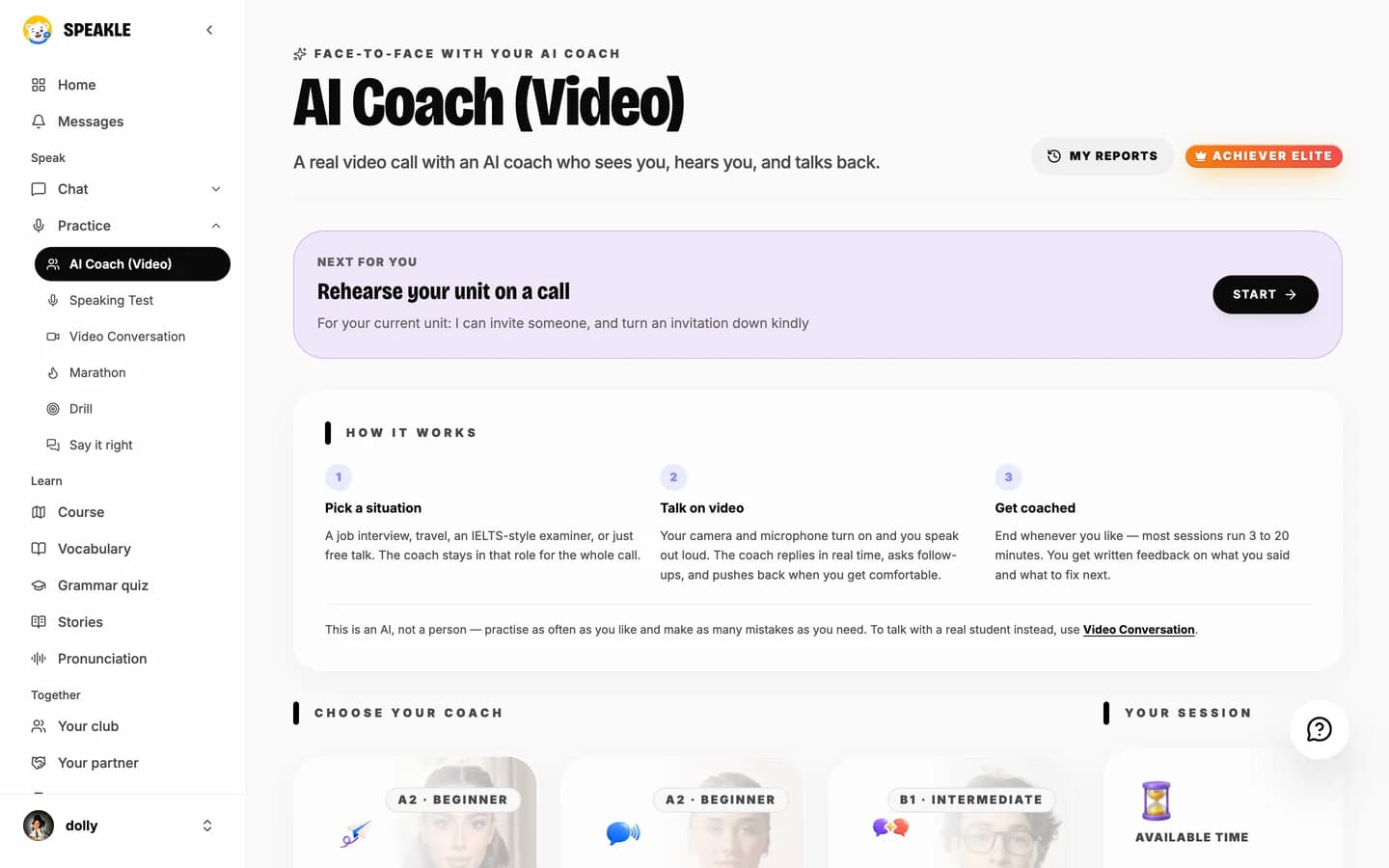 Live coachFace to face with an AI coach, on videoJob interviews, debates, travel, IELTS speaking or an open conversation. The coach stays in role for the whole call and nothing is scripted.
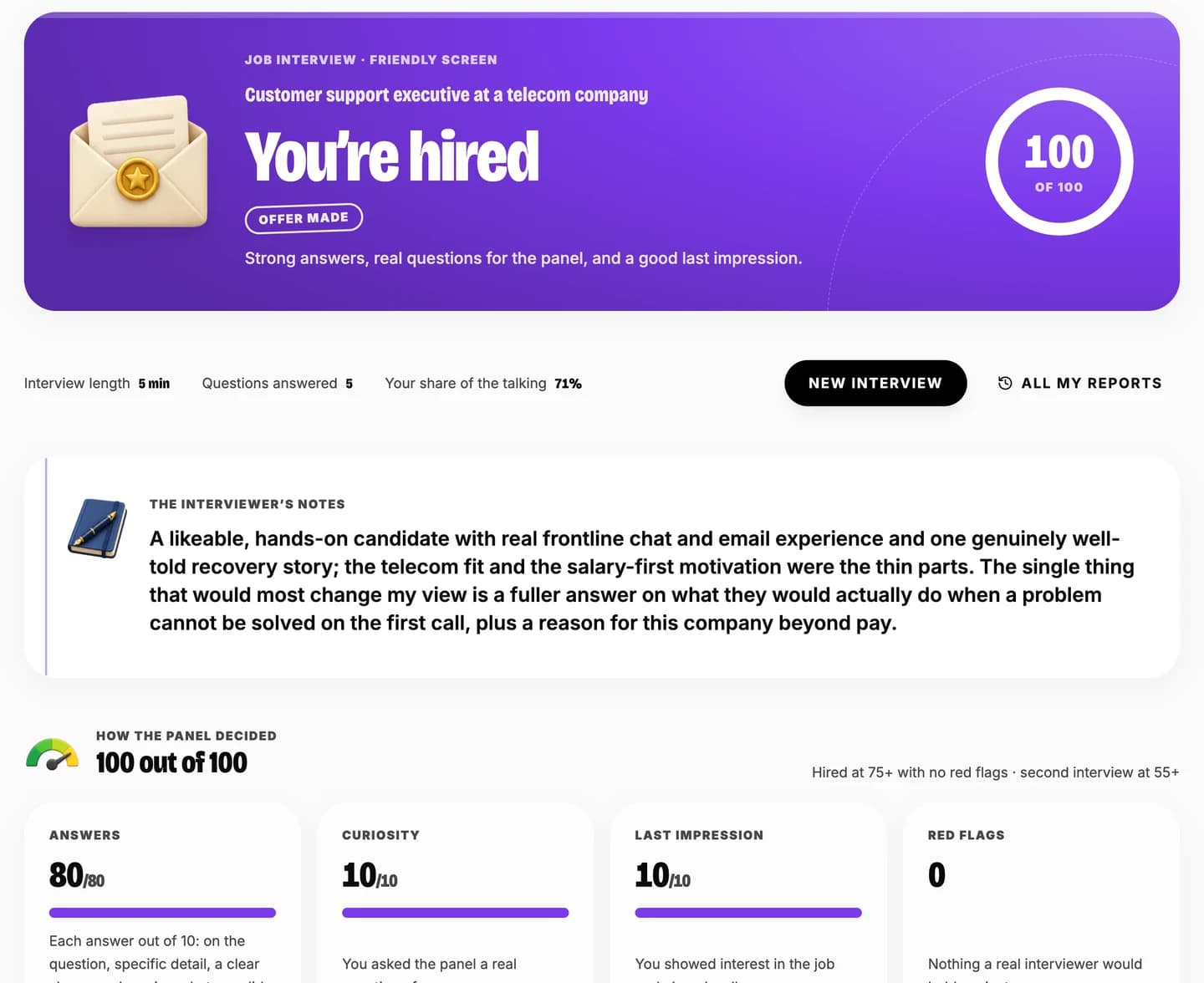 ReportsA report after every callAn interview ends in a hiring decision, a debate is won or lost, a trip earns a stamp at each stop.
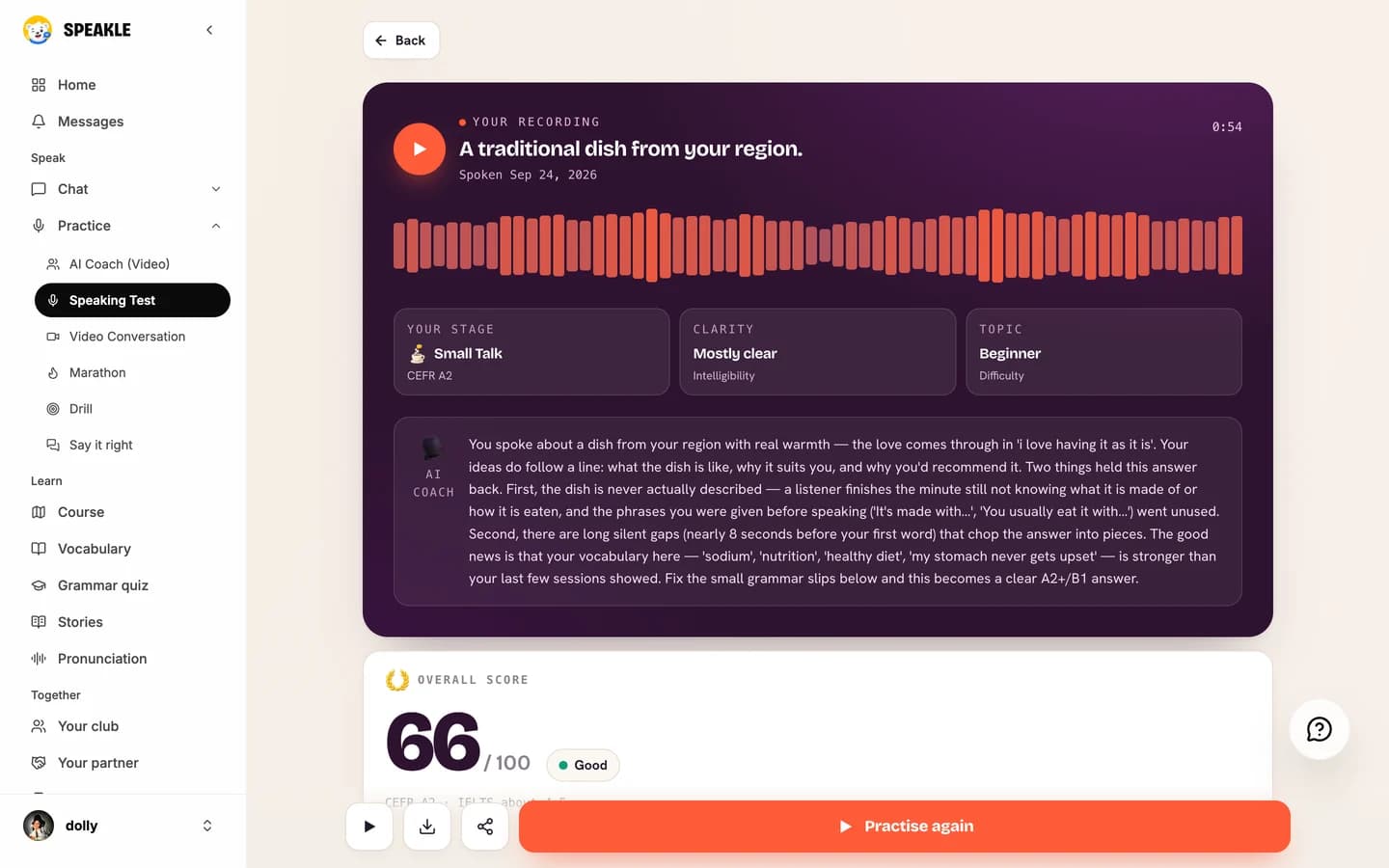 Every sessionYour speaking, measuredPronunciation, fluency, grammar, vocabulary and coherence, with a CEFR level and the one thing to fix first.
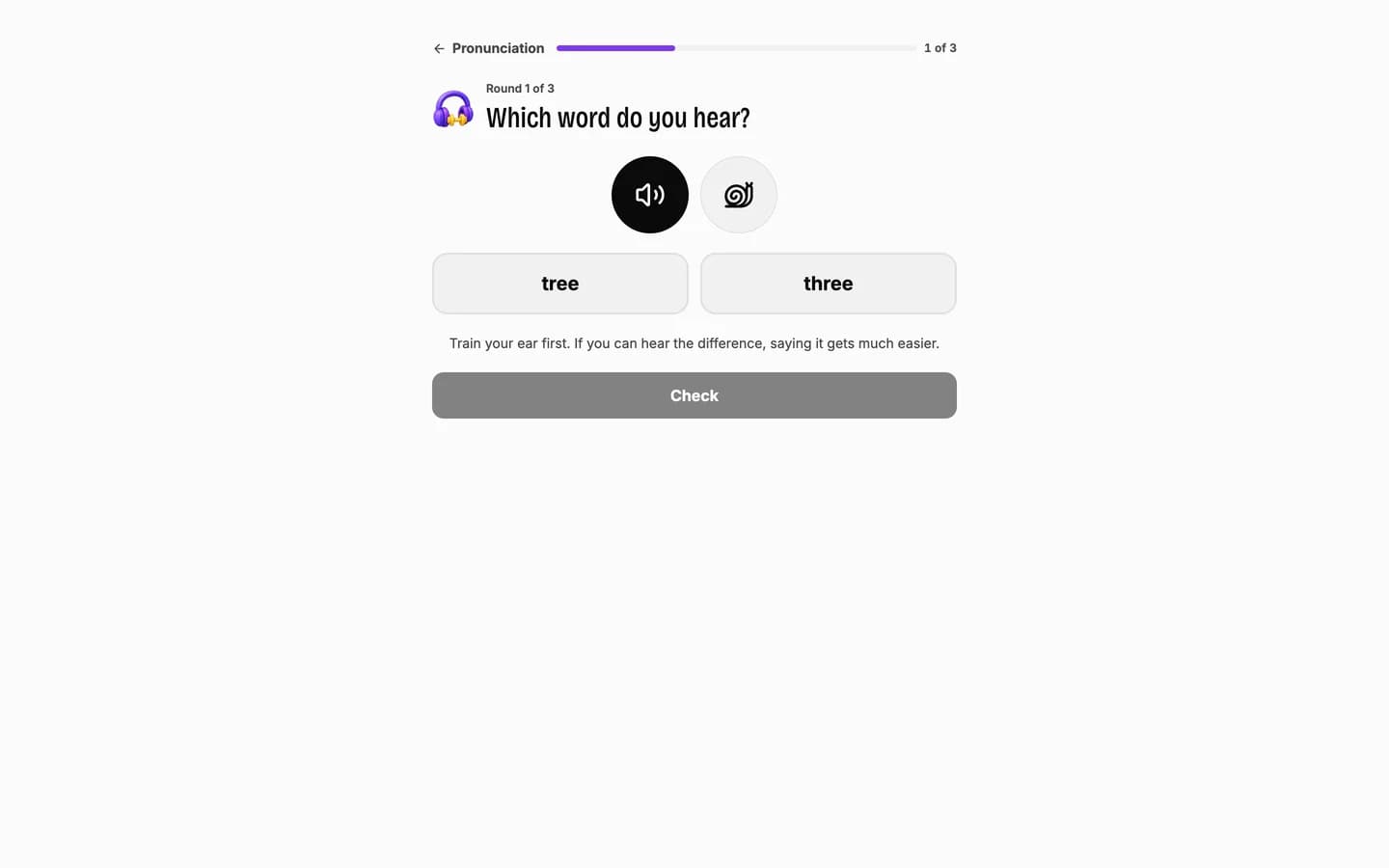 PronunciationPronunciation from your first languageSounds your language merges come first; sounds it already gives you are skipped.
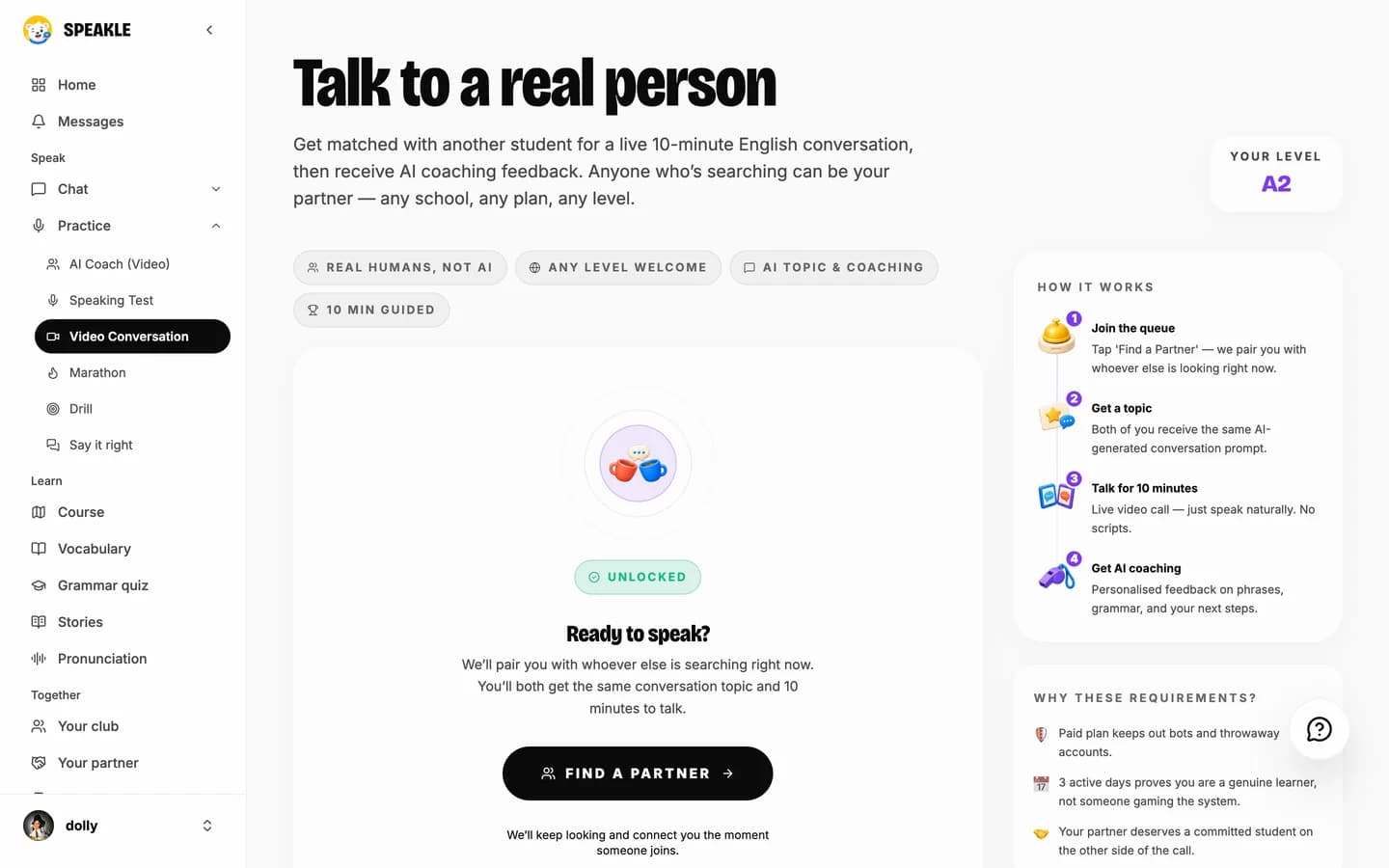 PeopleReal learners, on videoTen minutes with another learner at your level, then coaching on what you both said.
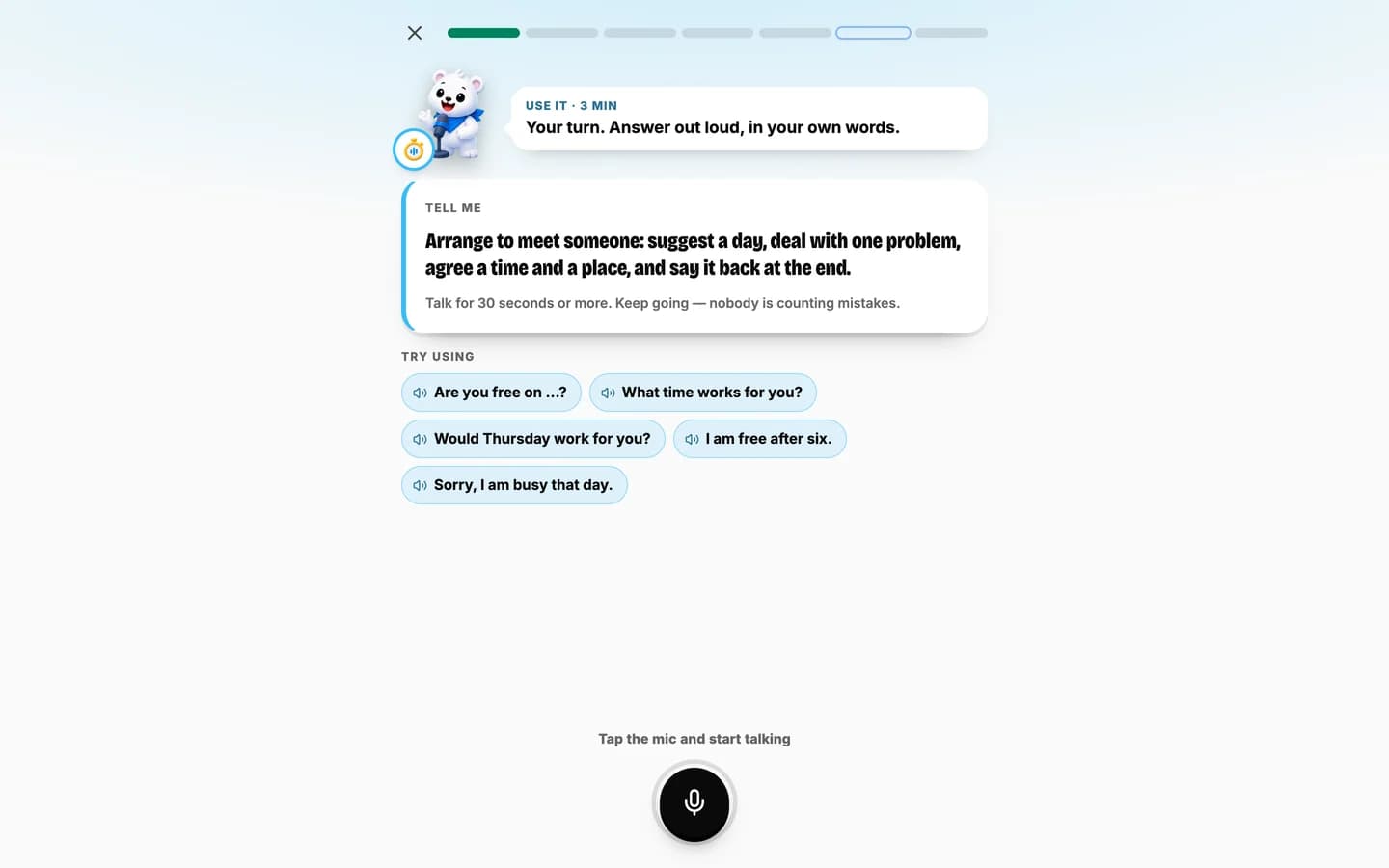 CourseA course where every step is spoken109 units from A1 to C2. Each step is a real task you say out loud, not tiles to tap.
C2 speaking questions (proficient)
At C2 you express yourself spontaneously, fluently and precisely, even on complex or abstract topics, and you adjust your tone to the situation. You can play with ideas, use understatement and humour, and explain subtle differences in meaning.
- Is it possible to be truly objective about your own culture? Why or why not?
- What does "success" mean to you, and how has your definition changed?
- Some say every generation believes the next one is worse. Why do you think this pattern exists?
- How far should a person change the way they speak to fit in with a new group?
- What is the most overrated piece of common advice, in your view?
- Can a hobby lose its value once you start doing it for money?
- How do you decide when to trust an expert and when to think for yourself?
- What would be lost if everyone in the world spoke only one language?
- Describe a small, ordinary moment that changed how you see something.
- If you could change one habit that most people share, what would it be and what might go wrong?
What a good C2 answer sounds like: natural, exact and unhurried. You choose the right word rather than a nearly right one, you shape the answer for your listener, and you can hold two opposing ideas at once without losing clarity. Nothing sounds rehearsed, and nothing is longer than it needs to be.
Model answer to "Can a hobby lose its value once you do it for money?":
"It can, though I don't think money is the culprit so much as obligation. The moment a hobby has a deadline and a client, you stop choosing when to do it, and choice was half the pleasure. I've seen friends who bake or take photographs go through exactly that. Some come out the other side, because the craft itself matters more to them than the freedom around it. Others quietly find a new hobby and keep the old one strictly professional. So the honest answer is that it changes the value rather than removing it. Whether that's a loss depends on what you were getting from it in the first place."
Useful phrases: "I don't think... is the culprit so much as...", "The honest answer is...", "It changes... rather than removing it", "I'd go further and say...", "Whether that's... depends on...", "There's a case for..., but..."
Tip: at C2 the work is in precision and restraint. Record one answer, then listen for any word that is nearly right and any sentence that adds nothing. Replace the first and cut the second. The best C2 speakers often say less than C1 speakers, and every word earns its place.
How to practise with these questions
A page of questions only helps if you use it. This routine takes about ten minutes and works at every level.
- Pick one question at your level and one from the level above. Two questions a day is plenty.
- Set a timer and record yourself. Aim for 30 seconds at A1 and A2, 60 seconds at B1 and B2, and up to 90 seconds at C1 and C2. Do not write the answer first. Planning in writing trains writing.
- Listen back once. Do not judge the whole answer. Notice one thing to fix: a word you searched for, a verb in the wrong tense, a sentence that trailed off, or a sound that was unclear.
- Answer the same question again, fixing that one thing. The second recording is almost always smoother, and hearing that improvement is part of what makes speaking less frightening.
- Keep the first recording. In a month, listen to it again. It is one of the clearest ways to hear how far you have come.
A few more things help. Use a question from a different topic each day, so you build words across work, food, travel, family and technology instead of one topic only. If a question feels too personal, answer as a character or talk about a friend. That is completely fine for practice. And if you freeze, say "Let me think for a moment" out loud and keep going. Recovering from a pause is a skill in itself, and the guide on why speaking English feels scary, and what actually helps has more on the moment your mind goes blank.
If you are practising for an interview, the job interview guide has the six questions that come up almost everywhere. If sounds are what trip you up, the pronunciation guide explains which ones matter most for people who speak your first language.
IELTS-style speaking questions and other exams
Many learners search for these questions because an exam is coming. The speaking part of well-known exams, IELTS among them, often follows a similar pattern:
- Short questions about you: home, work or study, free time, food. These are close to the A2 and B1 questions above.
- A longer turn: you are given a topic, such as "describe a trip you enjoyed" or "describe a person who helped you", and speak for one to two minutes. The B1 questions above work well as practice for this.
- A discussion: more abstract questions linked to the topic, where you give opinions and reasons. The B2 and C1 questions are good practice here.
Each exam has its own format, timing and scoring, so always check the official materials for the exam you are taking. What transfers from this page is the habit: answering unfamiliar questions out loud, at length, without a script. Examiners generally reward answers that are organised and extended over answers that are memorised, and memorised answers are usually easy to spot.
How the free Speakle speaking test uses one question like these
The free Speakle speaking test is built around exactly this kind of question. You get one everyday question, such as "What do you usually do on your days off?" or "Tell me about the people you spend the most time with", with a short hint to get you started. If you do not like the question, you can switch to a different one.
You then speak for 30 to 90 seconds, with no preparation. It takes about a minute, it is free, and you do not need an account. You get an estimated CEFR level from A1 to C2 straight away, with a few honest notes on what we heard.
A few things about how it works, so you know what the result means:
- It judges your language, not your accent. The level comes from the words and sentences you use: range, accuracy, how you connect ideas. Nobody is marked down for sounding like themselves.
- It is an estimate, not a certificate. One short answer on one day says less than a full conversation. A tired moment or an unfamiliar topic can move it, so treat it as a starting point.
- Your recording is private. It is not published or shared. If you do not save it to an account, the recording and result are deleted after a short time.
The test is a quick way to find which section of this page to practise from. If it says B1, work with the B1 and B2 questions for a few weeks, then take it again.
Practise every day with Speakle
These questions work on your own, with a recorder. What makes practice faster is feedback you can act on, and that is what Speakle is built to give. You answer a question out loud and get a report that starts with what you did well, then names one thing to work on next, with explanations in your own language if you want them. You choose how gently you are corrected: light, balanced or strict. There is no audience and no one watching, so you can get things wrong as often as you need to.
Speakle ships in nine native languages, and the questions are about ordinary life that travels anywhere: work, family, food, travel, weekends and plans. Beyond single questions, you can rehearse real situations, from a job interview to an everyday conversation, and follow a course that moves you up through the levels one step at a time.
The free plan includes a scored speaking session every day, and no card is needed. Start practising free, or if you would like to know your level first, take the free speaking test and come back to the section that fits you.
If you want to read more first, how Speakle scores your speaking explains what is measured and where the limits are, and the English speaking guide collects every guide in this series, including a step-by-step plan for building confidence.
References
- Cambridge University Press & Assessment. (2026). Guided learning hours. Cambridge English Support Site. support.cambridgeenglish.org/hc/en-gb/articles/202838506-Guided-learning-hours Checked 2026-09-26.