What this study is
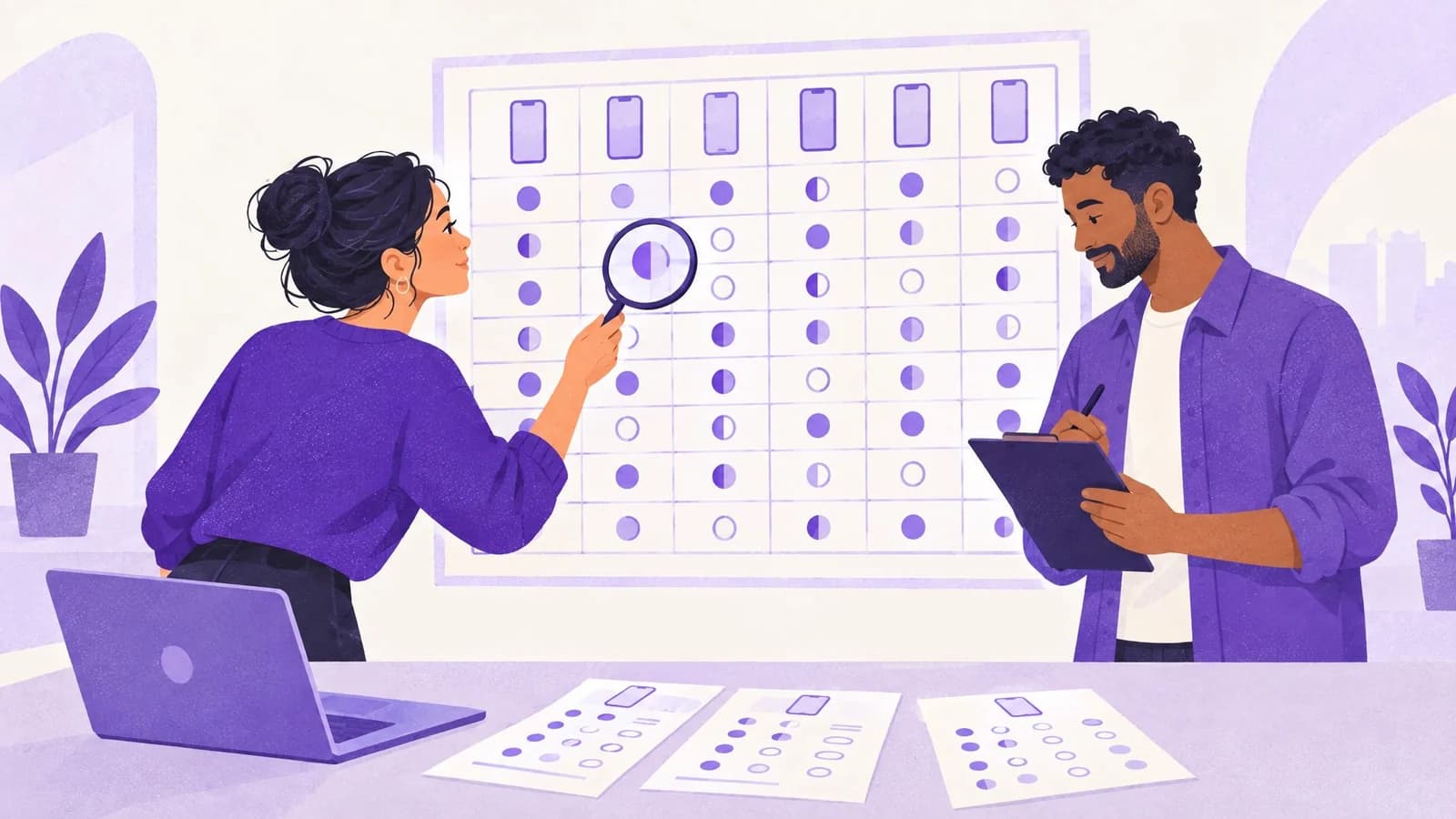
This is a list of what twenty English speaking apps say they offer, set out line by line. For each app we read its own public pages (its website, its help centre and its store listings) and recorded whether each of 25 capabilities is offered. Every answer links to the page it came from, so you can check any line yourself.
It is not a ranking and it does not score anything. An app with more marks is not a better app. A tutor marketplace and a pronunciation trainer are built for different jobs, and the right one depends on what you need to practise. If you want our own view of which kind of product suits which learner, that is a separate page: how the kinds of English speaking app compare.
Speakle publishes this study and is one of the twenty apps in it. That is a conflict of interest, and the method below is how we tried to keep it honest. If you find a line that is wrong, including one that flatters us, tell us and we will fix it.
How we checked each app
One rule decided what counted as evidence: the product's own words. We used the app's website, its help centre, its pricing page and its official listings on Google Play and the App Store. We did not use reviews, videos, forum posts or other comparison sites, because they go out of date and they disagree with each other.
Every cell has one of four answers.
- Yes. The product's own pages say it offers this.
- Partly. It offers something close, with a limit that matters. The note on the line says what the limit is, for example a feature that is only in the top plan, only on one platform, or only for business accounts.
- Stated as not offered. The product's own pages say outright that it does not do this. We used this answer only when there was a sentence to point to.
- Not found. We looked and found no public statement either way.
"Not found" is the answer to read most carefully. It does not mean the app lacks the feature. It means the feature is not described on the public pages we could read on the day we checked. Some help centres block automated readers, some features live behind a login, and some apps simply do not write everything down. A general assistant such as ChatGPT voice has many "Not found" lines because it is not sold as a language course and so does not describe itself in these terms, not because it cannot hold a conversation in English.
No prices appear anywhere in the study. They differ by country and change often, and a wrong price is worse than none.
What each capability means
A study like this is only as good as its definitions, so here is what had to be true for a "Yes" on the lines people most often read differently.
Open AI conversation means you can speak freely and the AI answers what you said. A fixed script where you repeat a given line does not count.
AI coach on video means the tutor appears as a talking face. A voice with a static picture does not count.
Pronunciation by word and pronunciation by sound are two lines on purpose. Many apps tell you which word was unclear. Fewer name the sound inside the word.
Remembers your mistakes means the app keeps a record of errors you repeat and builds later practice from that record. Saving new vocabulary for review is close, and is marked "Partly".
CEFR level estimate means the learner is shown a CEFR level. An app's own score that the company maps to CEFR in its documentation is marked "Partly".
IELTS speaking covers practice in the exam format as well as a band estimate. The note says which. No app's estimate is an official result, and that includes ours.
Free test, no account means a level or speaking test you can finish without signing up. A placement test inside the app after registration does not count.
Free speaking practice means some spoken practice without paying. A trial that asks for a payment method first is marked "Partly".
Hover over any capability name in the matrix to see its test, or open an app in the list under the matrix to read every line with its note.
Where this study can be wrong
We would rather you knew the weak points than found them.
The answers describe public pages, not the apps themselves. We did not install twenty apps and test each feature by hand. A company can describe a feature loosely, and a page can lag behind the product. Where the wording was thin, we marked "Partly" or "Not found" instead of guessing.
Several products are assessed for learning English specifically. Some apps offer a feature for other languages and not for English, or only when the app is displayed in certain languages. Where the public pages did not confirm the feature for English learners, the line is "Not found".
Some sources are the company's own blog posts. Those are still the company's words, but a blog post is weaker evidence than a help page, and a few lines rest on one.
Features change quickly. Every line was read on the date shown at the top of the matrix. That date only moves when the lines have been read again.
Speakle's own column follows the same rules. It has no human tutors to book, practice needs a connection, the iPhone app is in early access, and the live coach is on paid plans. Those lines are marked as such.
How to use or cite it
If you write about English learning apps, you are welcome to quote or reuse this matrix with a link back to this page. Please keep the date with it, since a line that was right in one month can be wrong in the next.
If you work on one of the apps listed and a line is wrong or out of date, write to us through the contact page with a link to the public page that shows the correct answer. We will update the line and the date. We will not change a line on request without a public source, for the same reason we did not use private sources ourselves.
If you are a learner choosing an app, use the matrix to rule things in, not out. Find the two or three capabilities you care about, see which apps state them, then try those apps. Most have a free tier or a trial. Ours starts with a free speaking test that needs no account, and the features page describes the rest.